On this page
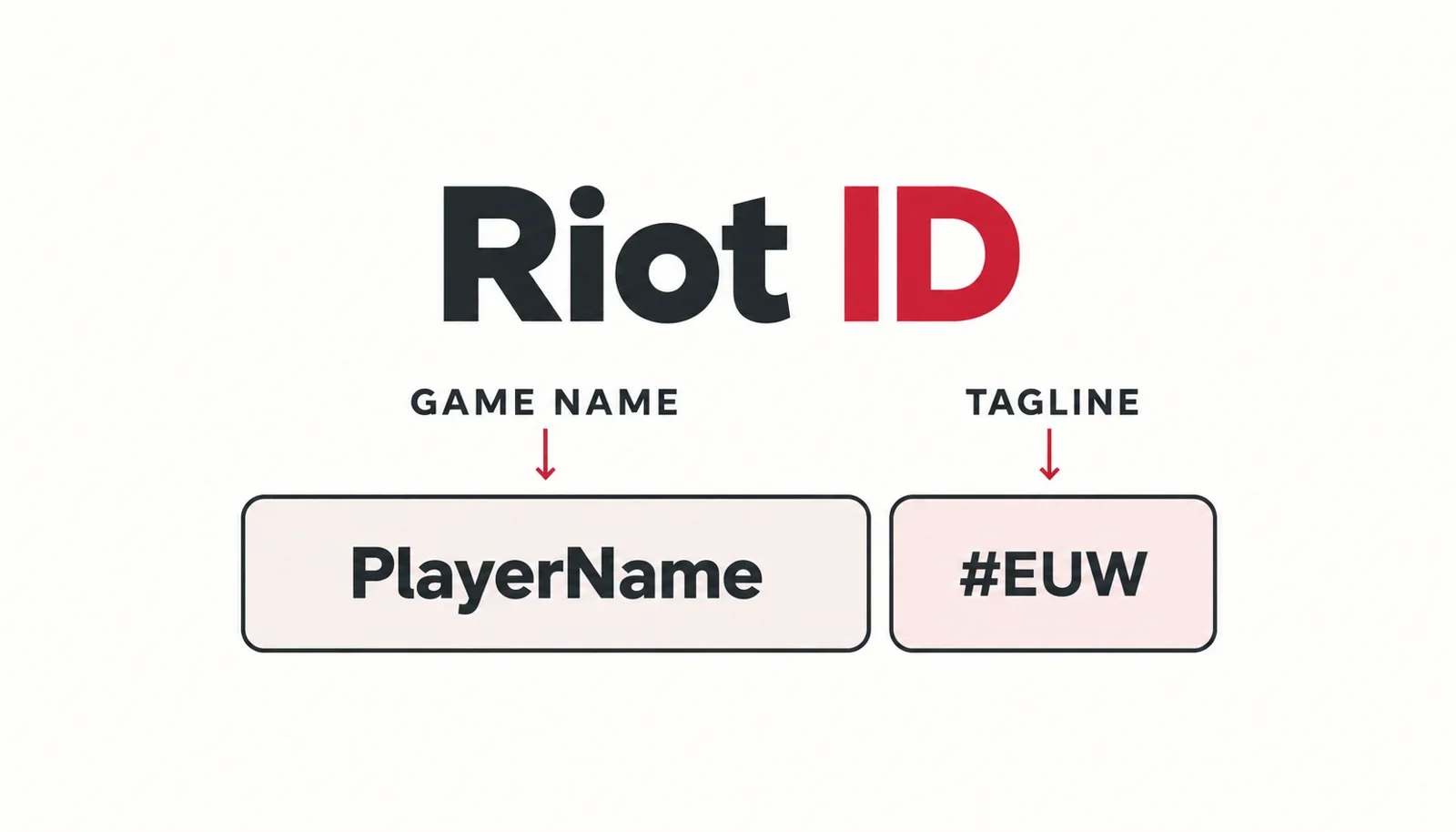
A useful LoL username starts with a game name you enjoy saying and a tagline that completes it. Riot IDs use the format GameName#Tagline, so consider both parts together when exploring ideas. Start with a clear identity—tactical, playful, understated, or duo-focused—then prepare several combinations you would happily keep.
Your Riot ID also follows you into Valorant and Teamfight Tactics. That makes a flexible name worth considering even if League of Legends is your main reason for choosing one. A name built around your personality can remain appealing when your preferred game or champion changes.
The examples below are original naming suggestions with unverified availability. Use them as starting points, adjust the words to suit your persona, and verify your complete preferred combination before adopting it.
Understanding the LoL Username Generator (algorithm and persona alignment)
The most useful starting point is a short description of the identity you want your name to express. Try phrases such as “quiet and tactical,” “committed to one pick,” “playful queue companion,” or “half of a coordinated duo.” This gives your choices a direction before you begin combining words.
Build around a recognizable idea
For a tactical persona, explore words such as Map, Tempo, Anchor, and Scout. For an understated aesthetic, try Quiet, Orbit, Mist, or Velvet. For a humorous identity, consider repetition, indecision, or queue-related wordplay without making the joke so elaborate that you dislike repeating it.
A simple naming pattern is a theme word followed by a complementary word:
- Map + Weaver →
MapWeaver#PATH - Quiet + Orbit →
QuietOrbit#LUMA - Same + Again →
SameAgain#MAIN - Pocket + Tempo →
PocketTempo#SYNC
These are creative patterns to explore. Choose the combination whose sound and meaning feel natural to you.
Match the persona to everyday use
Read each candidate aloud and imagine a friend using it during a match. If you would immediately shorten it, consider whether that shorter version should become the game name itself.
For a one-trick profile, words suggesting commitment or repetition can express the identity without naming a particular champion. For a duo, choose a shared theme while keeping each person’s name recognizable. For a broader summoner persona, favor an idea you would still enjoy outside your current role.
Procedural Syntax & Formatting Constraints for LoL Username Generator (character limits, legal casing, symbols)
The established structure is GameName#Tagline: a game name paired with a tagline. Treat the two fields as separate choices when reviewing an idea. In MapWeaver#PATH, for example, MapWeaver is the proposed game name and PATH is the proposed tagline.
Before committing, verify Riot’s current formatting requirements for each field. A name that looks attractive in a shortlist still needs to meet the requirements applied when you choose it.
| Detail to verify | Practical question |
|---|---|
| Game-name length | What minimum and maximum length currently apply to the game name? |
| Tagline length | What length range currently applies to the tagline? |
| Letters and numbers | Which characters are accepted in each field? |
| Capitalization | Is your preferred capitalization accepted, and how will it appear? |
| Spaces and symbols | Are any spaces, punctuation marks, or decorative characters permitted? |
| Content requirements | Does the proposed wording meet Riot’s current naming requirements? |
Keep styling easy to revise
Use straightforward lettering while developing your shortlist. For example, decide whether you like the words Quiet and Orbit together before spending time on decorative styling. That keeps the creative decision separate from the formatting details you still need to verify.
Mixed capitalization in these examples is a readability choice, not a statement about Riot’s treatment of letter case. If a particular spelling or symbol is essential to your idea, verify it early so you can revise the concept before becoming attached to it.
Check the complete pairing as well as its individual parts. A common game name can still be usable through its tagline.
Contextual Heuristics & Lexicons (breakdown of thematic keywords and prefixes)
A small, coherent word bank gives you a useful way to explore different versions of the same persona. Choose one row below, make a few combinations, and keep only those you would enjoy using. The categories describe creative moods rather than claims about playing ability.
| Naming direction | Opening words | Complementary words | Example pairing |
|---|---|---|---|
| Role or action inspired | Map, Lane, Tempo, Roam | Weaver, Anchor, Scout, Thread | LaneAnchor#HOLD |
| One-trick identity | Same, Steady, Repeat, Always | Again, Focus, Habit, Rhythm | SteadyFocus#MAIN |
| Queue humor | Pocket, Nearly, Maybe, Spare | Plan, Tempo, Again, Orbit | PocketPlan#NEXT |
| Understated aesthetic | Quiet, Velvet, Silver, Soft | Orbit, Echo, Mist, Ember | VelvetEcho#DUSK |
| Creative persona | Ink, Paper, Dream, Story | Weaver, Compass, Spark, Thread | InkCompass#TALE |
Choose a relationship between the words
Some combinations work because the words reinforce one another. SteadyFocus suggests a consistent tone. Others work through an unexpected pairing: InkCompass joins a creative image with a sense of direction. Neither approach guarantees a better name; compare how the results sound and what they suggest to you.
Avoid keeping a combination solely because both words appear in your preferred category. If the phrase feels awkward aloud, change one component or try a different order.
Give the tagline a purpose
A tagline can echo the game name, add a second idea, or connect two people’s names. These compact themes offer starting points:
- Direction:
NORTH,WEST,PATH - Atmosphere:
DUSK,MIST,LUMA - Commitment:
MAIN,FOCUS,AGAIN - Partnership:
PAIR,LINK,SYNC - Personal numbering: a short number sequence you are comfortable displaying publicly
Try SoftOrbit#DUSK for a consistent mood or SoftOrbit#MAIN for a more direct identity cue. The choice depends on which part of your persona you want to emphasize.
If you use numbers, choose something you can remember without explanation. Avoid including private information merely to make a candidate feel more personal.
Comparative Analytics: Generator vs. Manual Ideation (A complete HTML table comparing uniqueness, availability, speed, and suitability)
Choose a naming method according to the decision you need help making. Themed generation is useful for exploring combinations; manual ideation gives you room to develop personal meaning. Random strings and champion-based handles serve different preferences, but neither removes the need to verify a proposed Riot ID.
| Approach | Uniqueness considerations | Availability approach | Speed of exploration | Persona suitability |
|---|---|---|---|---|
| Themed generator ideas | Review the full game-name and tagline pairing | Prepare alternate taglines and verify each preferred pair | Convenient for reviewing several related candidates | Useful for role, aesthetic, humor, and duo themes |
| Manual ideation | Personal associations can guide distinctive wording | Verify the exact combination you develop | Allows deliberate exploration of fewer ideas | Useful when the name has a story or personal meaning |
| Random-string approach | An unusual appearance does not establish availability | Verify every candidate you consider | Useful for producing raw starting points | Consider whether the result expresses enough personality |
| Champion-based handle | Ties the name closely to a particular champion | Verify the full pairing | Straightforward when your reference is already chosen | Best considered alongside your willingness to keep that association |
Use a second pass to make the decision
After collecting ideas, compare your favorites manually. Ask which is easiest to say, which has the clearest tone, and which you would still enjoy after changing your preferred champion.
Champion-based names deserve particular thought because champions can be reworked, nerfed, or banned. Free Riot ID changes are also limited, making an enduring choice useful. A broader name can preserve your desired personality without depending on one champion remaining your preferred pick.
Availability-Friendly Riot ID Patterns and Tagline Strategy
A tagline can make a clean or common game name usable. Build your shortlist around complete pairings, and keep several alternatives you actually like. This gives you a practical next choice if your first combination cannot be used.
Keep the game name, vary the emphasis
Suppose QuietOrbit is your favorite game name. You might prepare:
QuietOrbit#DUSKfor an atmospheric pairingQuietOrbit#PATHfor a sense of directionQuietOrbit#MAINfor a commitment-oriented tone
These alternatives preserve the central identity while changing its emphasis. Pick taglines that feel intentional rather than treating every spare combination as equally appealing.
You can also reverse the process. If a tagline matters to you, explore several game names around it: QuietOrbit#LUMA, VelvetEcho#LUMA, or SilverThread#LUMA.
Coordinate a duo without merging your identities
For duo naming, choose a shared element and give each person a distinct counterpart. Examples include EchoNorth#PAIR with EchoSouth#PAIR, or QuietCompass#LINK with VelvetCompass#LINK.
Agree on the theme together, then check each complete ID separately. Decide in advance whether you would both accept alternate taglines or whether the shared spelling is essential to the concept.
Verify before settling on a favorite
- Write down the exact game name and tagline for each finalist.
- Confirm the current formatting and content requirements.
- Use Riot’s current ID selection or change process to check your preferred pairing.
- If it cannot be used, try the next prepared combination.
- Before confirming a change, review your current change eligibility.
If a tagline is refused, check any explanation provided rather than assuming the game name caused the problem. When changing an existing ID, verify which tagline choices are available at that point; a single unsuccessful attempt does not establish a general rule.
Frequently Asked Questions (4 high-intent questions and answers ready for FAQ Schema)
What is the Riot ID format for a League of Legends username?
A Riot ID combines a game name and a tagline in the format GameName#Tagline. For example, MapWeaver#PATH illustrates the two parts. Verify the current length, character, capitalization, and content requirements before choosing your final combination. Your Riot ID is used across Riot games, including League of Legends, Valorant, and Teamfight Tactics, so consider how the name suits you across those games.
Can two players have the same LoL game name if their taglines differ?
A common game name can be usable through a different tagline. Evaluate the complete pairing instead of discarding a game name simply because someone else uses those words. Prepare several taglines you like and verify the exact combination you want. Changing the tagline gives you another candidate; it does not confirm that candidate’s availability.
Are these generated LoL username ideas checked for availability?
No live availability check has been performed for the examples in this article. Treat them as creative suggestions and verify your preferred full ID through Riot’s current process. If a tagline is rejected, review the current requirements and any explanation provided. For an ID change, check which taglines you can select at that time rather than relying on an assumed list of unavailable choices.
Should I name my Riot ID after a champion, and how soon can I change it?
Choose a champion-based name if that association is something you expect to keep enjoying. Champions can be reworked, nerfed, or banned, so a broader one-trick or playstyle identity may suit you for longer. Free Riot ID changes are subject to a waiting period; verify your current eligibility and next eligible change date before committing. Remember that changing your Riot ID changes how you appear across Riot games.