Contents
A clan name generator turns a fuzzy team identity into a shortlist of usable names and tags. It is most useful when it produces banner-style faction titles, matched short tags, and style presets that fit a squad, guild, or esports community. The tool does not replace judgment: availability, platform limits, and trademark clearance still require manual checks before a name becomes official.
Understanding the Clan Name Generator
Clan names usually come from a simple but effective construction: a martial, mythic, atmospheric, or technological modifier fused with an institutional collective noun. Crimson joins Legion; Shadow joins Syndicate; Iron joins Vanguard; Void joins Covenant. The result reads like a banner or faction title rather than a random username, which is why the pattern works for squads, guilds, esports teams, and role-play communities.
A generator supports that pattern by pairing a modifier list with a collective-noun list and then deriving a short tag from the result. The tag is not an afterthought; in tag-aware tools it is generated as part of the same matched pair. Batch output matters because naming is a social decision. A team can generate a shortlist, compare options, and vote instead of arguing over one name at a time. Common batch sizes range from 5 to 50, with 5, 10, and 20 being practical defaults for a quick session.
Style presets keep the output aligned with the group’s persona. Aggressive presets lean on threat, force, and dominance. Short presets favor clean one-word names and compact tags. Mystical presets use arcane, celestial, or occult vocabulary. Acronym presets build names around a pronounceable tag. The generator is a starting point, not a clearance service: it creates candidates, while the team still has to check fit, availability, and tone.
Interactive Tool Widget Architecture
The above-the-fold widget is a self-contained naming surface. It should open with an H1 that names the tool, followed by a one-sentence prompt that tells the visitor what to do. Four niche tag pills can route the output toward common use cases such as Gaming, Esports, Fantasy, and Meme. A count selector for 5, 10, or 20 results lets the visitor control the size of the shortlist, and a large trigger button starts generation.
Results should appear as dynamic cards, not as a page reload. Each card can show the full clan name, the bracketed tag, a short style label, and two actions: Copy and Favorite. Copy writes the name or tag to the clipboard. Favorite stores the card in localStorage so a visitor can return to a shortlist without creating an account. The generator itself can run entirely client-side from bundled word lists, which keeps the interaction fast and predictable.
The architecture should also support regeneration without losing favorites. A visitor may generate a batch, favorite three options, change the count, and generate again. The tool should not imply that a name is available in a game or on a platform. Its job is ideation and formatting, not verification. That distinction keeps the widget useful without creating false confidence about availability.
Procedural Syntax & Tag Formatting Constraints
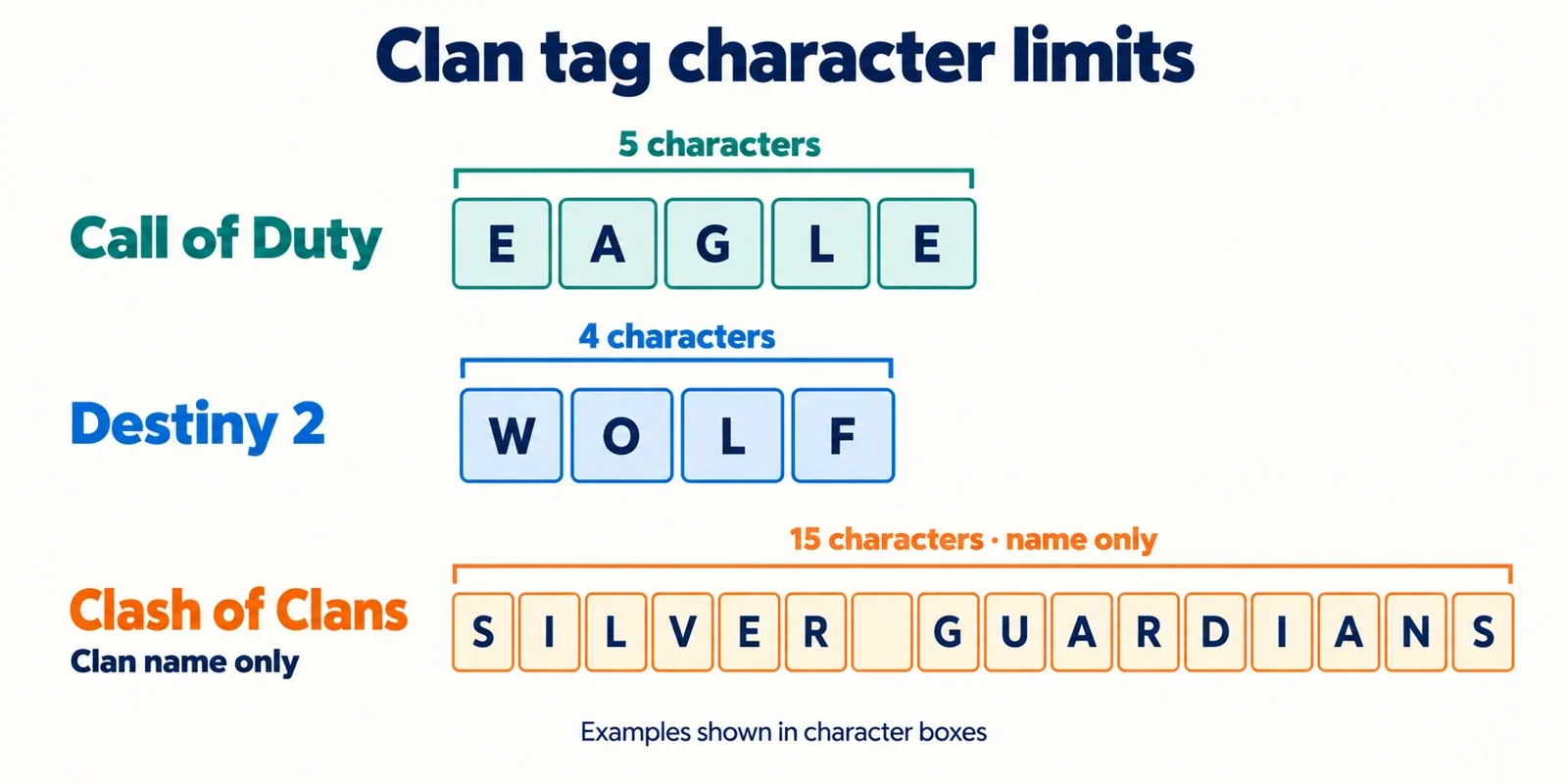
Tag formatting is the binding constraint in clan naming. Many shooters allow only a few characters in the tag, and the exact ceiling varies by title. Call of Duty, Destiny 2, and Clash of Clans are familiar examples of different rules: some use short bracketed tags, while Clash of Clans relies on a capped clan name rather than a separate tag. Because these limits can change, the safe workflow is to check the current in-game settings or platform support page before committing.
Casing should be deliberate. All-caps tags are easy to scan beside member names, but they also increase the risk of letter confusion. Lowercase l can look like uppercase I, and O can look like zero. Leetspeak and numerals can make a tag feel distinctive, yet they often hurt searchability, voice-call clarity, and reporting. If a tag needs to be explained every time it is read aloud, it is probably too clever for a team environment.
Unicode brackets and pipe characters can stylize a display name, but support varies by game, platform, and font. Square brackets, vertical bars, and angle-style marks may render differently or be stripped entirely. Keep the full name compact and the tag much shorter, then test the exact string in the target interface because supported lengths and symbols vary. Overlong multi-word constructions tend to collapse in menus, scoreboards, and social profiles. Naming guidance often recommends designing the short tag first, because it appears beside every member’s name in every match, then building the full clan name to fit that tag.
Contextual Heuristics & Thematic Lexicons
Lexicon choice should track genre. High-fantasy MMOs favor institutional terms such as Order, Brotherhood, Covenant, Guild, and Keep. These words imply history, hierarchy, and shared obligation. Sci-fi tactical shooters lean toward Syndicate, Vanguard, Dominion, Directive, Cell, and Protocol, which sound organized, technical, and mission-driven. A fantasy name that works for a role-play guild may feel out of place in a competitive shooter, and a tactical name may feel too cold for a casual community.
Casual and meme-oriented groups can use acronyms, self-aware names, and short comic phrases. The risk is that a joke name ages quickly or becomes difficult to recruit under. A better approach is to keep the joke in the tag or motto while giving the full name a clearer identity. Nature-plus-clan patterns are a separate tradition: a nature word fused with the suffix clan, such as Emberclan or Frostclan, can work without a separate tag and follows the pattern familiar from the Warrior Cats books. That style is best when the community is explicitly fandom-oriented.
Phonetics matter as much as theme. A clan name should be shoutable in voice chat without repeated clarification. Plosive consonants and clean two-syllable shapes tend to carry well. Avoid names that sound like common callouts, map locations, or other teams’ abbreviations. The best matched pair is easy to say, easy to type, and easy to remember after one match.
Comparative Analytics: Generator vs. Manual Ideation
The comparison below treats algorithmic generation, manual brainstorming, and committee voting as different naming methods rather than as competitors. Each has a different strength profile.
| Method | Uniqueness | Availability confidence | Speed | Genre suitability | Best use |
|---|---|---|---|---|---|
| Algorithmic generator | Medium to high for volume; common patterns can repeat | Low; no live database check | Very high | High when style presets match the genre | Producing a broad shortlist quickly |
| Manual brainstorming | High when the group has a strong internal reference | Low to medium; still requires manual checks | Medium | High when the group knows its own tone | Finding a distinctive name with personal meaning |
| Committee voting | Medium; compromise can flatten edge | Low; voting does not verify availability | Low | Medium to high if the voters represent the community | Building buy-in and reducing later disputes |
A generator is strongest at volume and formatting. It can produce 20 candidates in a few seconds and keep name-tag pairs consistent. Manual ideation is stronger at distinctiveness, especially when the team has a private joke, a shared history, or a specific visual identity. Committee voting is slower, but it improves adoption because members feel ownership of the final choice.
The practical workflow is hybrid: generate a batch, shortlist five, check each name and tag manually on the target platform, then let the group vote among verified options. That sequence uses the generator for what it does well without treating it as an availability oracle.
Availability, Legal, and Trademark Boundaries
Clan name generators do not check whether a name or tag is already taken in a game, on a platform, or across social media. They also do not perform trademark clearance. A generated result is a candidate, not a reservation. Before committing, the team should check the in-game clan or guild interface, the platform handle settings, the Discord server name or vanity URL, and any social accounts the team plans to use.
For casual play, the main risks are duplication, impersonation reports, and the annoyance of changing a name after members have adopted it. For commercial esports branding, the risk profile is higher. Team names can overlap with existing organizations, merchandise brands, or registered marks. A generator cannot tell you whether a name is clear for commercial use, and it cannot grant rights. If the name will appear on jerseys, sponsor decks, or paid events, consult qualified counsel and search the relevant trademark registers before investing in logos, domains, or merchandise.
Free use is usually a separate question from legal clearance. A generated name may be used as inspiration for a Discord server or amateur team, but the tool’s terms still apply, and output is not exclusive. Another group may generate or choose the same name. Availability-friendly patterns include adding a distinct but pronounceable modifier, avoiding famous team names, and keeping the tag short enough to fit platform limits. Verification remains a manual step, and it should happen before the name becomes part of the team’s identity.
Frequently Asked Questions & Schema Readiness
How long should a clan tag be for most games?
Use the shortest tag that remains readable. Many shooters work best with a few characters, but the exact limit varies by title. Design the tag first, then fit the full name around it, because the tag is what appears beside every member’s name.
Can I use generated clan names for my Discord server or esports team for free?
Whether you can use a generated name for free depends on the generator’s terms and how you use it. A generated name may be usable as inspiration, but free use does not mean exclusive rights or trademark clearance. Check the terms, avoid famous marks, and obtain legal advice before commercial esports branding.
Will one clan name and tag work across multiple games?
Sometimes, but not always. Tag limits, allowed symbols, and name caps differ by game and platform. A portable name should be short, avoid Unicode dependency, and keep a clean fallback tag that fits the strictest target.
Do these generators check whether a clan name or tag is already taken?
No. They generate candidates from word lists and formatting rules. The team must verify availability in the target game, on platform handles, and on social accounts before committing.
These Q&A pairs are formatted for FAQPage structured data, with each answer kept self-contained.