Apex username generator
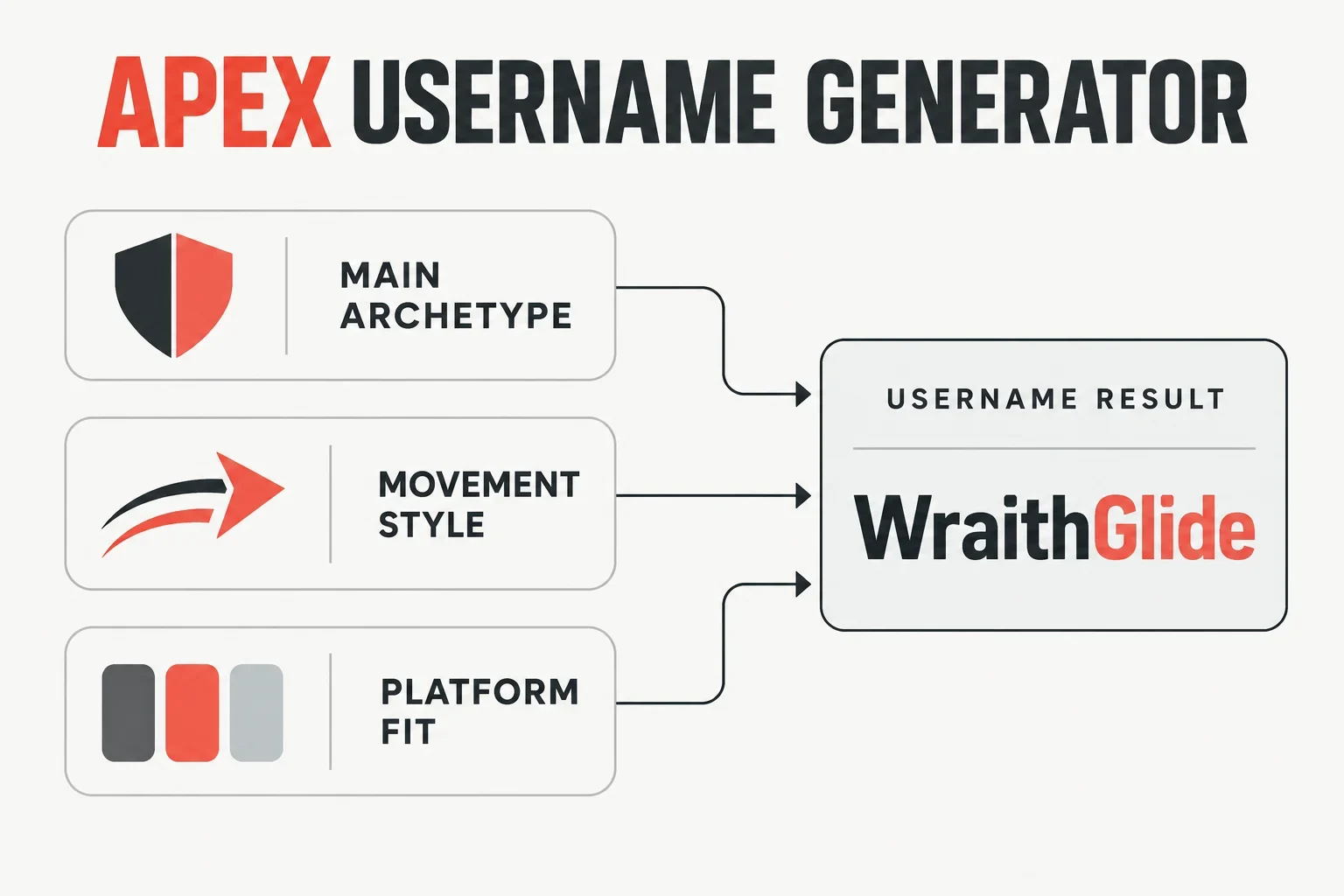
An Apex handle has to work in three places at once: the account name field, the kill feed, and voice chat. This generator approach maps a player’s main legend to an archetype, adds a movement-style token, and optionally folds in a rank goal or squad tag. The result is a short, readable handle that feels Apex-specific without copying a legend name or leaning on a temporary season reference. The tool produces drafts; the player still confirms availability and originality on the platform.
Apex Main-Legend Identity Mapping
Main-legend identity works best when the generator maps a legend to an archetype instead of copying the legend’s name. Useful archetype labels include recon scout, support anchor, controller hold, entry skirmisher, and assault pressure. Each label can carry a small set of ability verbs: scan, pulse, shield, dome, portal, zip, grapple, drone, trap, phase, and rush. The player chooses the main, and the generator uses the archetype and verb family as seed material.
For example, a recon main can produce a prefix such as Scan, Pulse, or Trace; a support main can produce Shield, Dome, or Relay; a controller main can produce Hold, Trap, or Zone; a movement main can produce Zip, Slide, or Grapple. The suffix should add a human role, such as Scout, Lead, Main, Anchor, or Runner. Avoid using the exact legend name as the whole handle, and avoid strings that imply official affiliation. The result should feel like a player identity, not a copied character label.
Names based on play style age better than names tied to a current game, meta, or seasonal reference. By mapping the main to an archetype, the generator gives the player a durable identity that stays usable after a season rotation or a balance patch. This mapping also prevents the common mistake of piling adjectives onto a legend name, which usually produces a long, unreadable handle that fails voice-chat checks.
Movement-Style Naming Taxonomy
Movement-style naming should use short, concrete verbs and nouns that survive voice chat. A practical taxonomy is: slide family (Slide, Drift, Low, Glide), grapple family (Grapple, Hook, Swing, Tether), zip family (Zip, Line, Rail, Wire), wall-bounce family (Bounce, Kick, Wall, Spring), rotate family (Rotate, Relay, Shift, Path), and rush family (Rush, Push, Break, Breach). These components are short enough to combine with a role suffix without creating a long, unreadable handle.
Favor two-beat constructions such as SlideScout, ZipLead, or GrappleMain. A two-beat handle is easy to say, easy to remember, and easy to repeat in a lobby. Avoid dense consonant clusters, ambiguous letter swaps, and strings that look like random keyboard noise. The handle should be readable aloud on the first attempt because teammates may need to spell or repeat it in every match. Movement words also age better than seasonal slang, so the generator should prefer them over temporary meta references.
The taxonomy can be expanded with secondary terms for each family, such as WallKick, RailHop, or ZoneShift, but the core stays short. The goal is not to catalog every possible movement technique but to give players a small set of tokens that read clearly in a fast-paced game. A player who loves wall-bouncing might choose Bounce- or Kick-; a player who values map rotation might pick Rotate- or Shift-. Each token remains distinct enough to avoid confusion in kill-feed text.
Platform Handle Constraints and Availability
Platform handling should be conservative. A generator cannot guarantee availability, and it should not pretend to have a live API for Xbox, PlayStation, Steam, Switch, Discord, or Epic. Instead, it should apply a platform-aware formatting preset, label every result as a draft, and send the player to the platform’s official account settings to confirm the final name.
A safe default is a 3-16 character ASCII core using letters, numbers, and at most one separator. Xbox and Switch benefit from short, simple cores. PlayStation and Epic can tolerate a hyphen or underscore in many cases, but the generator should not assume every symbol is accepted. Steam and Discord allow longer display names, yet the Apex-facing core should still stay short for kill-feed readability. Discord handles have their own casing and symbol rules, so a lowercase-safe variant is useful. The generator should also provide a no-separator variant and a short fallback for each result.
Availability checks are manual: open the platform’s account-name or username settings, enter the draft, and confirm whether it is accepted. For Discord, check the username field in the app. For console and storefront accounts, use the official rename flow. The generator should never claim a handle is available until the platform confirms it.
The generator can include a note in the result card: "Check availability on your platform." This keeps expectations honest and avoids misleading the player into thinking the draft is guaranteed. Platform layouts change, so the generator should not hardcode a fixed set of allowed characters; instead, it should prompt the player to verify the current rules.
Kill-Feed and Squad-Tag Formatting
Kill-feed recognition depends on a short visible core, a clean separator, and a predictable shape. The best handles usually keep the personal core to one or two beats and avoid stacked numbers, excessive symbols, and mixed casing that looks like a different word when truncated. If a separator is needed, choose one platform-safe character and use it consistently. The generator can offer a hyphen, underscore, or dot as options, but it should default to the safest option for the selected platform.
Squad identity should be a shared prefix, not a shared full name. A two-to-four-character squad tag plus a separator plus a unique personal core gives the group a recognizable banner while preserving individual identity. For example, a squad can share a short tag and vary the second beat: one member uses a movement word, another uses a support word, and another uses a rank-goal word. The tag should be easy to pronounce and not look like an official clan claim. Avoid making every member’s handle identical with a trailing number; that pattern is hard to read and easy to forget.
The generator can allow the player to input a custom squad tag and then combine it with a movement or role token. This preserves the shared identity without forcing the same full name. The tag should be limited to a few characters to keep the kill feed readable, and it should be filtered for trademark or impersonation risks.
Generator Widget UX and Result Cards
The widget should sit above the article as the primary tool. Its H1 is ‘Apex Username Generator’; its subtitle is ‘Build a main-based, movement-first handle that reads clean in voice chat.’ Four tag pills can frame the intent: Gaming, Movement, Main-Based, and Squad. The count selector offers 5, 10, and 20 results. The trigger button says ‘Generate Apex Names’. Each result card shows the handle, a short pronunciation hint, a platform-fit badge, a Copy button, and a Favorite button. Copy writes to the clipboard with a visible confirmation. Favorite stores the handle in localStorage under a simple key such as apex-name-favorites, and the saved list can be toggled without a page reload.
The client-side arrays should be theme-specific, not generic. A workable prefix set is: Void, Phase, Grapple, Zip, Slide, Bounce, Rush, Rotate, Scan, Pulse, Shield, Dome, Portal, Drone, Trap, Climb, Peak, Squad, Drop, Flank, Relay, Ping, Arena, Rank. A workable suffix set is: Scout, Runner, Lead, Main, Tag, Path, Line, Shift, Dash, Step, Call, Mark, Frame, Core, Rig, Kit, Arc, Loop, Zone, Edge, Point, Trace, Signal, Climb. The generator combines one prefix and one suffix, then checks for duplicate tokens, awkward double letters, and platform length. A regex-based balancing step can trim or swap tokens before rendering so the card is less likely to show a truncated artifact. The same card can offer a no-separator, underscore, and hyphen variant.
The widget should be fully client-side with no page reload. The count selector and generate button update the result cards instantly. The favorite list can be shown or hidden with a small toggle, and each saved handle can be removed. The copy button should show a brief ‘Copied!’ state. The widget must not claim availability; it only produces drafts.
Comparative Evaluation: Generator vs Manual Ideation
Procedural generation and manual ideation solve different problems. Manual ideation gives the player full control and can produce a deeply personal name, but it is slower and often biased toward the first few ideas. A generator is faster and more varied, but it needs editorial seed data and a clear originality check to avoid generic output. The table below compares the two approaches on the factors that matter for an Apex handle.
| Factor | Procedural Generator | Manual Ideation |
|---|---|---|
| Uniqueness | High volume of combinations; can still collide without a final search. | Can be highly unique when the player draws on personal references. |
| Availability | Cannot guarantee live availability; produces drafts to check. | Player can check each idea as it is created. |
| Speed | Fast, repeatable, and useful for exploring many directions. | Slower; depends on the player’s vocabulary and patience. |
| Apex-specific suitability | Strong when seeded with legend archetypes, movement verbs, and rank goals. | Variable; may drift into general gaming words. |
| Voice-chat readability | Can enforce two-beat, separator, and length rules. | Depends on the player’s judgment. |
| Originality risk | Medium if the arrays are generic; lower with curated Apex-specific seeds and filters. | Low when the player avoids copied names and trademarks. |
A generator is best used as a starting point. It can quickly produce a shortlist of drafts that the player then personalizes or filters. Manual brainstorming remains valuable for players who want a highly personal reference. The two methods are not mutually exclusive; the generator can support manual tweaks by allowing the player to edit the generated handle before copying.
FAQ and Schema Intent
FAQ content should answer the exact questions players type before they commit to a handle. Keep each answer short enough to match the visible text, and use FAQPage schema only when the same question-and-answer pairs are present on the page. Do not promise live availability, and do not claim that a generated name is unique.
Frequently Asked Questions
How can an Apex username reflect my main without using the legend’s exact name?
Map the main to an archetype and an ability verb. A recon main can use Scan, Pulse, or Trace; a support main can use Shield, Dome, or Relay; a movement main can use Zip, Slide, or Grapple. Pair that seed with a human role such as Scout, Lead, or Anchor.
Which movement-style words make short kill-feed handles?
Slide, Zip, Grapple, Bounce, Rotate, and Rush are strong because they are short, concrete, and easy to say. Two-beat forms such as SlideScout, ZipLead, and GrappleMain read quickly and survive truncation better than long phrases.
What character limits should the generator enforce across platforms?
Use a conservative 3-16 character ASCII core by default, then offer platform presets. Xbox and Switch need the shortest cores; PlayStation, Steam, Discord, and Epic can vary, so the final check belongs in each platform’s official account settings.
How should squad identity tags be formatted without making every member’s handle identical?
Use a shared two-to-four-character tag, a separator, and a unique personal core. The tag creates recognition; the second beat preserves individual identity. Avoid trailing numbers on every member and avoid tags that imply an official clan or sponsorship.
Risk, Compliance, and Originality
Originality and compliance are part of the product, not an afterthought. The generator should filter out exact legend names, ability names used as the entire handle, developer or publisher names, pro-player names, and any string that implies official affiliation. It should also filter hateful terms, personal data, and impersonation patterns. A name that looks like a support ticket, a cheat advertisement, or an official staff account creates avoidable risk.
Searchability cuts both ways. A highly unique handle is easier to find and harder to confuse with someone else, but it can also be memorable for the wrong reason if it is offensive or misleading. The generator should show a short originality reminder, encourage a final platform search, and avoid seasonal rank language that will date the handle. Play-style names age better than names tied to a current meta, season, or temporary badge. The final responsibility for the name still belongs to the player.
The generator should also avoid suggesting names that include special characters that might be reserved for system accounts. A filter for common admin or support patterns is wise. The originality check should compare the generated handle against a small internal list of known trademarks and common offensive patterns, but the player should still perform a platform search to ensure no one else has the same name.