On this page
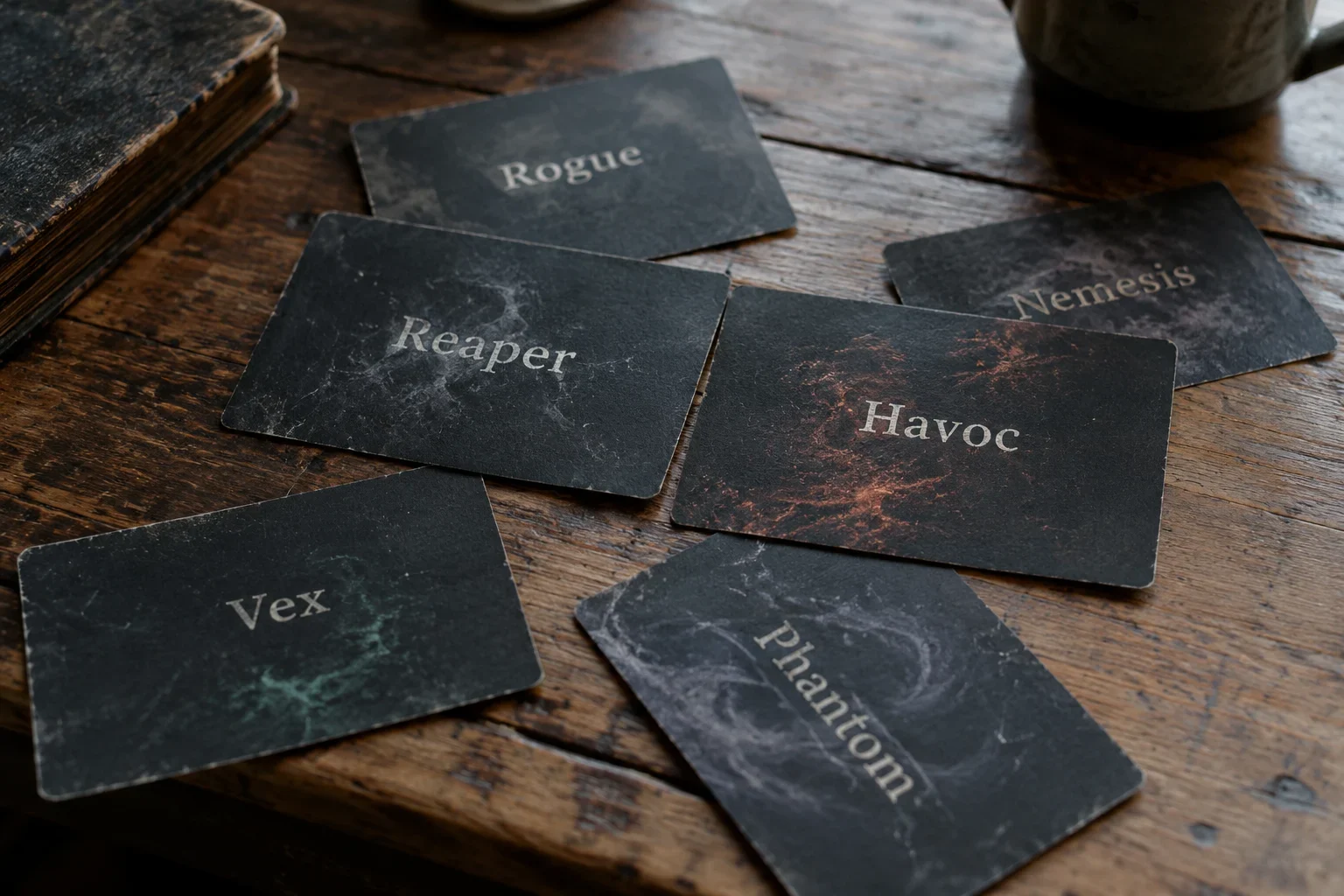
A great edgy gamertag does two jobs at once: it sounds intimidating in a lobby, and it still reads cleanly when someone has to type it into a friend request. That balance is the whole design brief here. The generator assembles villain-style names from a curated pool of shadow, void, and havoc vocabulary, then lets you copy or favorite the ones that land. Below the tool you will find the reasoning behind the word pools, the formatting rules that keep names legible, and a clear-eyed look at why platform naming constraints resist being summarised as a single number. One thing the generator deliberately does not do is promise that a name is free — availability is a live, per-platform state, checked at the moment you claim it and nowhere else.
Interactive Tool Widget and User Flow
The generator is a single panel placed above the fold, titled Edgy Gamer Name Generator and introduced by one short line: build a dark, aggressive, villain-style tag in seconds. The point is that a visitor can arrive, pick a mood, and leave with a shortlist without scrolling, signing in, or reading a tutorial first.
Theme pills
Four pills sit directly under the subtitle, and each one swaps the vocabulary underneath rather than merely filtering the same output:
- Gaming — general competitive language suited to shooters, MOBAs, and battle royales.
- Villain — mastermind framing: schemes, dominion, executioner energy.
- Shadow — stealth and nocturnal tones: veil, dusk, hollow, silence.
- Aggressive — blunt force: havoc, ruin, feral, relentless.
The active pill is visually distinct, and switching pills clears the current batch so the screen never mixes themes.
Count selector and trigger
A segmented control offers 5, 10, or 20 names and defaults to 10. The primary button is large, high-contrast, and labelled Generate Edgy Gamer Names. Pressing it produces a fresh batch in place, so you can regenerate repeatedly without losing your spot on the page.
Result cards
Each name appears on its own card with two controls:
- Copy places the name on your clipboard and confirms with a brief Copied state.
- Favorite marks a name you want to keep so you can find it again on a later visit.
Favorites belong to that browser and device rather than to an account, so treat them as a scratchpad, not an archive.
Where the names come from
The word pools are compact, theme-specific lists of prefixes and suffixes that get recombined each time you generate. Small pools that recombine well stay on-tone better than a sprawling scraped database, and they keep the vocabulary reviewable — which matters when the whole brief is "dark, but not a liability."
End-to-end flow
Pick a pill, choose a count, generate, copy or favorite the keepers, regenerate for a new batch. That is the entire interaction; there is nothing to configure and no account to create.
Honesty and accessibility
A short line under the button states plainly that the tool produces suggestions and does not check whether a name is already taken. Results are announced to screen readers as they appear, cards are reachable by keyboard, and focus states stay visible.
Dark and Aggressive Lexicon Design
Most strong gamertags follow a three-part anatomy: a modifier that sets the tone, a core noun that carries the imagery, and an optional tail that sharpens the silhouette. The word pools below are built around that structure so the output stays coherent instead of reading like two random words stapled together.
Prefix pool (modifiers and atmosphere)
Shadow, Void, Reaper, Havoc, Dread, Abyss, Obsidian, Grim, Wraith, Null, Vex, Malice, Cinder, Onyx, Sable, Rift, Hex, Blight, Doom, Specter.
These lean on absence and threat rather than gore. Void and Null imply erasure; Obsidian and Onyx imply hardness and cold; Vex and Malice imply intent.
Suffix pool (cores and tails)
-born, -fang, -claw, -blade, -wraith, -shade, -storm, -grave, -hex, -rift, -bane, -maw, -thorn, -scythe, -veil, -crypt, -howl, -reaver, -talon, -ember.
Aggressive modifiers
Savage, Brutal, Vicious, Relentless, Feral, Ruthless, Merciless, Wicked, Iron, Crimson, Venom, Static.
A strong adjective paired with a predator, a weapon, or a class reads as confident rather than try-hard, which is exactly why that combination suits shooters and battle royales where the name flashes past on a kill feed. Iron Reaver and Crimson Talon do more work than a longer, louder phrase because the imagery resolves instantly.
Platform-safe alternatives
Violence-adjacent language is where edgy names most often cross a line. The safer move is to trade explicit harm for atmosphere:
- Instead of gore and kill framing, use erasure and silence: Voidwalker, Silent Reaper, Hollow Veil.
- Instead of real-world weapons, use mythic or abstract ones: Riftbane, Hexscythe, Gravehowl.
- Instead of stacking numbers and symbols for shock value, use one sharp word pair: Grimhollow, Dreadmaw.
- Instead of anything referencing a protected group, a real person, or an extremist symbol, use invented compounds that belong to nobody.
What the pools deliberately exclude
Slurs and group-directed hostility, sexual content, drug references, real-world extremist iconography, impersonation of platform staff or well-known creators, and symbol spam. These are not just bad taste — they are the categories most likely to trigger enforcement, and the fastest way to lose an account you have invested years in. A name can be menacing without being a liability.
Platform Naming Constraints and Compliance
Every platform publishes its own naming rules, and third-party summaries of those rules disagree often enough that repeating a specific number is a reliable way to be wrong. Treat any published limit as provisional and confirm it on the platform’s own support page at the moment you are choosing a name. This section is a reading list, not a spec sheet.
Why there is no character count printed here
Limits differ by platform, they change without much notice, and the summaries that circulate online conflict with one another — most visibly for Xbox, where different sources quote different ceilings. A number copied into an article is stale the moment it is written, and a stale number is worse than no number, because it sends you into a rename screen with the wrong expectation. The durable advice is simple: open the support page for the account you are actually naming and read the current rule there.
Where the official answers live
- Xbox support — gamertag rules, how duplicate names are handled, and the rename process.
- PlayStation support — online ID rules, including length and how often an ID can be changed.
- Steam support — profile name rules.
- Nintendo support — Switch nickname rules.
- Discord support — username and display name rules.
- Twitch help — username, display name, and impersonation policy.
- Roblox support — username rules and content policy.
- Epic Games account help — display name rules and any cooldown between changes.
Each of those pages is the authority for its own platform. Nothing on this page overrides them, and no generator can.
Three structural differences that matter more than any single number
- Unique handle versus visible name. On some services, the name other players read and the unique identifier behind it are separate fields with different rules and different uniqueness behaviour. Before you fall in love with a name, find out which field you are actually filling in.
- Discriminators and suffixes. Where a service resolves duplicates by appending a discriminator or suffix, two players can carry the same readable name and be told apart by the tail. "Available" then means something narrower than it sounds.
- Change friction. Renames may be free, paid, rate-limited, or restricted after a first change. Assume you get one good decision and make it deliberately.
Content policy risk
Beyond length, every platform enforces conduct and content rules covering hate speech, harassment, sexual content, drug references, real-world violence, and ban evasion. Enforcement is often automated and often triggered by reports, which means a name that survives a filter can still be removed later. The conservative reading of a rule is always the cheaper one.
The availability caveat
Availability is a live, per-platform state that changes minute to minute and usually requires being signed in to query. The tool on this page makes suggestions; the claim happens on the platform, and the check happens there too.
Procedural Syntax and Formatting Rules
Formatting is where edgy names most often fail. A name that looks devastating in a preview can become unreadable in a kill feed, unspeakable in voice chat, and unsearchable in a friend request. The generator applies a consistent set of rules to every output.
Length target
Aim for roughly six to fourteen characters: long enough to be distinctive, short enough to survive narrow display fields such as scoreboards, party lists, and friend requests. Names under four characters tend to collide with existing ones, and very long names get clipped somewhere in the interface — and the clipped version is the one people will see.
Casing
Two patterns only: TitleCase (VoidReaver) or all-lowercase (voidreaver). All caps tends to read as shouting rather than menace once a name runs long, so reserve it for short names. Random mixed casing is out entirely — it makes a name look like a captcha.
Symbols
At most one separator, and only where it clarifies a word boundary. Underscores are risky because they disappear in some fonts and render as a blank gap in others. Skip leading symbols: they break alphabetised lists, look like formatting artifacts, and are stripped by some clients on display.
No leet-speak
The rule is simple: if you would not say it out loud to a teammate, it does not ship. R34p3r is worse than Reaper in every measurable way — slower to read, harder to search, impossible to dictate, and it signals 2007 rather than menace. Substitutions that survive the rule are rare; the honest count is close to zero.
Readability tests
- The say-it test: can you pronounce it in one breath without spelling it out?
- The squint test: at small size, does it still separate into recognisable shapes?
- The substring test: when the two tokens are joined, does the seam accidentally form an offensive word? Concatenation creates words nobody intended, and automated filters catch them even when the author did not see them.
- The search test: could you find this name in a friend search by typing roughly what it sounds like?
Syllable count
Two or three syllables is ideal. One syllable reads as a codename; four or more reads as a sentence fragment and gets shortened by other players anyway, usually to something you did not choose.
Numbers
Avoid them at the start. Trailing numbers are acceptable when they are part of the persona rather than a fallback for a taken name — a string of digits after a dictionary word is the universal signal that the good version was already claimed.
Comparative Analytics: Generator vs. Manual Ideation
Both approaches produce names. They differ in what they optimise for, and the right choice depends on whether you need volume or a single perfect fit.
| Criterion | Generator | Manual ideation |
|---|---|---|
| Uniqueness | High volume of unusual two-token combinations a person would rarely assemble by hand; some outputs still feel formulaic within a theme | Highly unique when it works, because it draws on personal references, in-jokes, and niche vocabulary a word pool cannot contain |
| Availability | No check performed; popular word pairs are more likely to already be claimed on services with unique handles | Slightly better odds, since personal references are less contested — but still no guarantee |
| Speed | Seconds for a batch of 5 to 20 names, with instant regeneration | Minutes to hours, plus dead ends when a favourite turns out to be taken |
| Suitability | Consistent tone by construction; the theme pills keep output on-brief | Variable — brilliant one day, derivative the next, and hard to judge your own work objectively |
| Readability control | Enforced by rule: length, casing, symbol, and substring checks applied to every output | Depends entirely on the author’s discipline; leet-speak and symbol clutter creep in easily |
| Creative ownership | Lower — you are selecting rather than inventing | Higher — the name is unmistakably yours, which matters for long-term identity |
| Best use case | Fast shortlisting, alt accounts, squad naming, breaking a creative block | A main account you intend to keep for years |
Reading the table
The generator wins on throughput and consistency. It removes the two failure modes that plague manual brainstorming: staring at a blank page, and falling in love with a name that turns out to be unreadable or against the rules. Manual ideation wins on originality and personal attachment, which is why the strongest workflow uses both — generate a batch to shake loose vocabulary you would not have reached for, then hand-tune the one that catches your eye.
Neither column solves availability. That is a platform query, not a naming problem, and treating it as a naming problem is how people end up disappointed at the claim screen.
FAQ and Schema Markup
Each answer below is written to stand alone, so it can be reused in structured data without editing.
How can I make an edgy gamer name dark and aggressive without violating platform guidelines?
Lean on atmosphere instead of harm. Words about absence, cold, and silence — void, hollow, veil, obsidian, dusk — read as menacing without touching violence. Pair one strong modifier with one sharp noun and stop there. Avoid slurs, sexual content, drug references, real-world extremist imagery, and impersonation of platform staff or known creators; those are the categories most likely to trigger enforcement. A name like Grimhollow or Voidwalker carries the same weight as an overtly aggressive one and is far less likely to be reported.
What are the character limits for Xbox, PlayStation, Steam, Discord, and Twitch gamertags?
They differ by platform, they change, and published summaries frequently conflict — particularly for Xbox. Rather than trusting a number from a third-party list, confirm on each platform’s own support page: Xbox support for gamertag rules, PlayStation support for online ID rules, Steam support for profile names, Discord support for username and display name rules, and Twitch help for username, display name, and impersonation policy. As a number-free rule of thumb, keep the name compact: a six-to-fourteen character name is the safest bet across narrow display fields and leaves room for a discriminator if the service appends one.
Does an edgy gamer name generator check whether a name is available?
No. Availability is a live, per-platform, per-region state that usually requires an authenticated session to query. The generator assembles suggestions from a word pool; it performs no availability lookup, and any static page that claims otherwise is describing something it cannot verify. Always check on the platform itself before you get attached to a name, and remember that on some services the visible display name and the unique handle are two different things.
How do I avoid leet-speak and unreadable symbols in a villain-style gamertag?
Apply three tests. Say the name out loud — if you have to spell it, cut it. Squint at it at small size — if the letterforms merge, cut it. Read the joined tokens as one string — if the seam forms an offensive word, cut it. Then strip substitutions like 3 for e and 0 for o, cap yourself at one separator or none, and keep the name in the six-to-fourteen character range. Menace comes from word choice, not from punctuation.