Contents
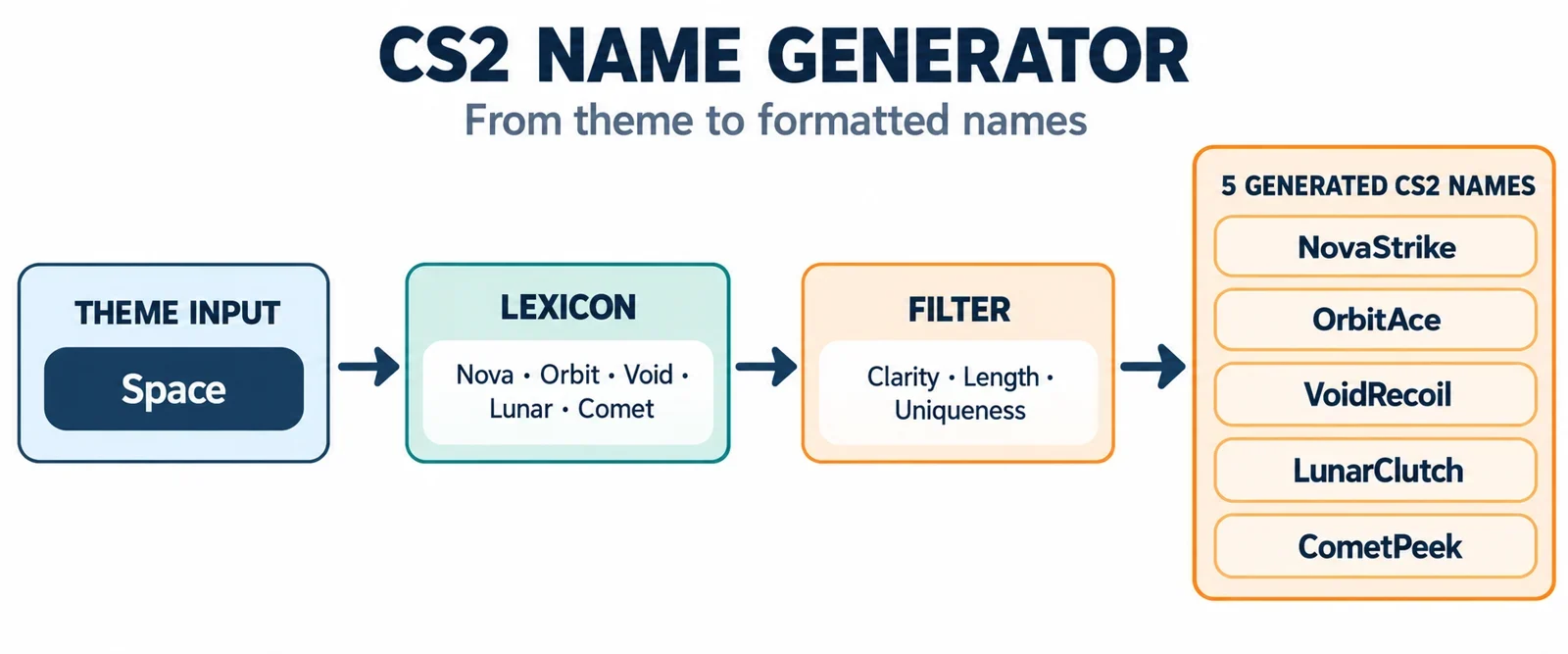
CS2 names have to do two jobs at once: look sharp on a profile and survive the comms channel. This CS2 Name Generator focuses on Premier rating, utility play, map updates, and modern esports style, producing short, readable tags that suit profiles and team lineups. It is aimed at players who want names such as PremierSmoke, UtilityAce, or AnubisCall rather than random strings. The generator uses themed prefixes and suffixes, applies formatting filters, and returns a small batch of options that can be copied or saved. The sections below explain the logic, constraints, lexicons, and trade-offs.
Understanding the CS2 Name Generator (Algorithm and Persona Alignment)
A CS2 name generator is not just a random word mixer. It works best when it combines three inputs: the player’s intended persona, the current CS2 vocabulary, and the formatting limits of the platform where the name will appear. CS2-specific tools often separate clean and sweaty IGNs, with themes such as esports, utility play, and modern competitive style. That distinction matters because a support player may want a utility-first tag, while an entry fragger may want something sharper and more aggressive.
Four-Stage Generation Flow
At a high level, the generator follows four stages. First, it selects a persona template: rifler, AWPer, entry fragger, support or utility player, anchor, or in-game leader. Second, it draws from theme lexicons: Premier rating language, utility callouts, map-update references, and esports jargon. Third, it applies readability filters for length, casing, symbols, and syllable count. Fourth, it removes weak duplicates and returns a small batch, often five names by default.
Persona alignment is the part that keeps outputs from feeling generic. An AWPer template can favor angle, hold, peek, and flick language. An entry template can favor rush, open, entry, and trade. A support template can favor smoke, flash, molly, lineup, and execute. An IGL template can favor call, default, system, tempo, and retake. The ‘2-Syllable Comms’ rule is useful here: names with one or two syllables are easier to call out instantly in high-pressure shooters like CS2.
A typical workflow is to choose the game context, filter by vibe or persona, add a flair keyword or clan tag, and then copy or save the names. The generator should create player aliases, not in-game name tags for items. That distinction keeps the tool focused on the name a player uses on a profile and in a lineup, rather than an item rename.
Procedural Syntax & Formatting Constraints for CS2 Names
CS2 naming starts with separating three identifiers: the Steam account name, the public Steam profile name, and the SteamID. The profile name is the visible label players can change in Steam settings; the account name and SteamID are not the same thing. Many generators default to a 4-20 character range and return five names per batch so tags remain readable in scoreboards, kill feed, and team lineups. Steam’s exact maximum length for the profile name can be verified in current Steam support documentation.
An in-game name tag is different again. It renames an item and is not a player alias. A generator should not imply that a name tag changes a player’s alias, because that would confuse two separate systems. For player names, the practical target is the profile name and the name shown in match contexts.
Casing and Symbols
Valid casing matters. TitleCase, lowercase, and ALL CAPS all work, but mixed casing should stay intentional. Symbols can add flair, but excessive Unicode, invisible characters, or decorative brackets may break callouts or look inconsistent on third-party platforms. Font choices such as Gothic, Lightning, Japanese Brackets, and bold or sans styles can add personality, but a plain-text fallback is safer for team lineups and comms.
Random numbers and leetspeak should be used sparingly. A number can help reduce duplicates, but it can also make a tag feel like a password. Leetspeak can date a name and slow down reading. The generator should therefore prefer clean words, short compounds, and readable prefixes or suffixes over clutter. Instant copy to clipboard and device-stored favorites are useful because they let users compare options without retyping them.
For team lineups, consistency beats novelty. A shared prefix, a clan tag, or a common casing pattern can make a roster look organized. Keep each tag short, avoid near-duplicates, and test whether the name is easy to say in a crowded voice channel.
Contextual Heuristics & Lexicons
The lexicon is where a CS2 generator gains its character. Premier rating themes draw from rank, queue, stack, rating, and competitive progression language. Utility themes draw from smoke, flash, molly, nade, lineup, execute, default, and retake. Map-update themes draw from active-map names and callouts such as Ancient, Anubis, Vertigo, Overpass, Nuke, Mirage, Inferno, and Dust II. Modern esports themes draw from entry, anchor, trade, clutch, tempo, system, IGL, and AWP roles.
Prefix-Suffix Pattern
A useful pattern is prefix plus suffix. The prefix sets the theme, and the suffix sets the action or identity. Examples include PremierSmoke, UtilityAce, AnubisCall, EntryTrade, NadeLine, RetakeHold, AWPangle, and IGLDefault. The best results are short enough to read at a glance and specific enough to sound like a player rather than a keyword list.
| Theme | Prefix examples | Suffix examples | Persona fit |
|---|---|---|---|
| Premier rating | Premier, Rating, Queue, Stack, Rank | -call, -play, -tag, -line | Competitive rifler, queue grinder, stack player |
| Utility play | Smoke, Flash, Molly, Nade, Lineup | -exec, -default, -retake, -util | Support player, utility specialist, IGL |
| Map updates | Ancient, Anubis, Vertigo, Overpass, Nuke | -mid, -site, -hold, -rotate | Anchor, rotator, map specialist |
| Modern esports | Entry, Anchor, Trade, Clutch, Tempo | -peek, -trade, -clutch, -ace | Entry fragger, AWPer, rifler, IGL |
A ready-to-use generator lexicon can include prefixes such as Premier, Rating, Utility, Smoke, Flash, Molly, Nade, Lineup, Trade, Clutch, Anchor, Rotate, Entry, AWP, Rifle, Boost, Default, Execute, Retake, Eco, Force, Rush, Mid, Site, Overpass, Ancient, Vertigo, Nuke, Mirage, Inferno, and Anubis. Suffixes can include -tag, -line, -play, -call, -stack, -setup, -exec, -hold, -peek, -trade, -clutch, -ace, -boost, -default, -mid, -site, -retake, -eco, -force, -rush, -comms, -aim, -flick, -spray, -util, -smoke, -flash, -molly, -rotate, and -anchor.
The heuristic should not overstuff a name. One theme plus one role cue is usually enough. If a tag needs a number, a bracket, and three keywords to make sense, it is probably too long for CS2 comms.
Comparative Analytics: Generator vs. Manual Ideation
A generator and manual ideation solve different parts of the naming problem. Manual ideation can feel personal, but it is slow and tends to recycle familiar words. Comparative benchmarks from similar shooter-friendly tools report that manual ideation is much slower and has lower availability, while a generator scores high on uniqueness and generation speed. Those results are directional rather than guarantees, but they explain why a themed generator is useful for producing many readable options quickly.
| Factor | Generator output | Manual ideation | Practical takeaway |
|---|---|---|---|
| Uniqueness | High when the lexicon is broad and duplicates are filtered | Can be high, but often clusters around familiar names | Use the generator for variety, then refine one favorite |
| Availability | Heuristic only; no external database check | Usually low because users pick names they already know | Verify the final name on the target platform |
| Speed | Fast batch generation | Slow, especially when testing many ideas | Generate a shortlist, not a single forced option |
| Suitability | Strong when persona and theme filters match | Precise but inconsistent | Match the tag to rifler, AWPer, entry, support, anchor, or IGL |
| Customization | Prefix, suffix, clan tag, keyword, casing | Unlimited but time-consuming | Combine generator speed with manual polish |
| Consistency | Repeatable formatting and length rules | Varies by user and mood | Use syllable and character filters for lineups |
Availability is the main limitation. A generator can reduce collisions by combining themes and filtering duplicates, but it cannot confirm that a name is free on Steam, FACEIT, or another platform without an external lookup. That is why the best workflow is hybrid: generate a batch, keep two or three favorites, and then check the final choice where it will be used.
Frequently Asked Questions (FAQ)
How does the generator ensure names are suitable for both profile use and in-game name tags?
The generator creates player aliases, not in-game item name tags. It focuses on the profile name and the name shown in match contexts, while following Steam’s distinction between profile name and account name. For item renames, players use a separate in-game name tag system.
Can generated names be used on FACEIT or other third-party platforms without modification?
Usually they can be used as plain text, but each platform has its own length, symbol, and content rules. Generated names do not check platform availability. Remove decorative symbols if they slow down callouts, and verify the final name on the target platform.
How do themes like utility play or Premier rating influence the generated tags?
They change the lexicon and the weighting. Premier themes draw from rating, queue, stack, and rank language. Utility themes draw from smoke, flash, molly, lineup, execute, and retake language. Persona weights then favor tags that fit riflers, AWPers, entry fraggers, support players, anchors, or IGLs.
What distinguishes a good CS2 gamer tag from a bot-like or generic one?
A good tag is short, sayable, readable, and tied to a clear identity. It avoids random strings, excessive numbers, leetspeak clutter, and symbols that slow callouts. The best tags sound like a player, not a password.