Contents
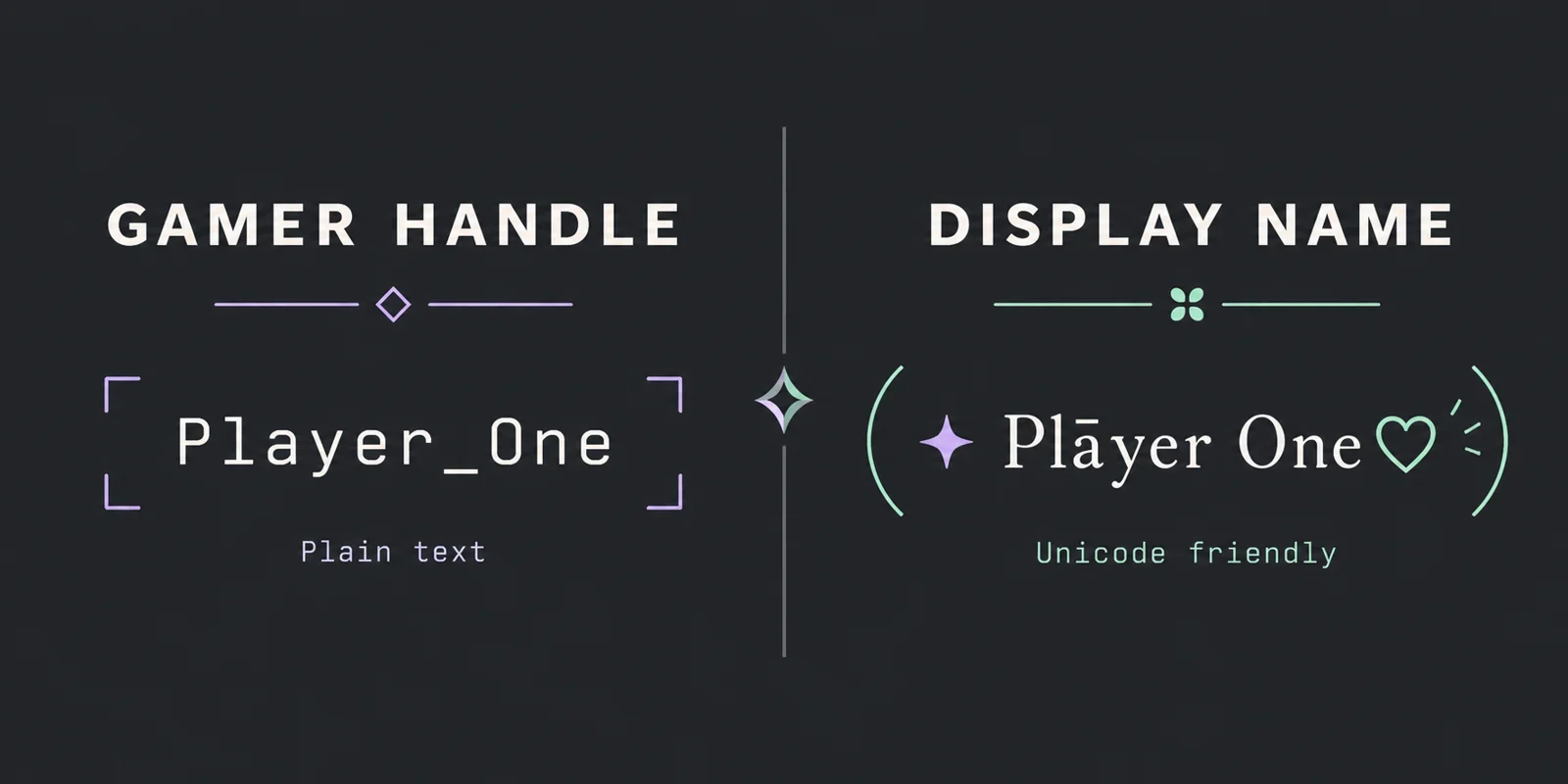
Aesthetic gamer names sit between taste and technical limits. A name such as hazy.blossom looks simple, but the same string may fit one platform field and fail another. The safe design habit is to start with a plain-text version that uses only letters and numbers, because that version must survive the most restrictive field the user cares about, such as a PSN or Xbox-style handle. Decoration can come later, and only after the exact platform field has been checked.
This guide treats the aesthetic gamer name generator as a constrained naming tool. It covers the platform layer, where compatibility is field-specific rather than universal; the style layer, where lowercase forms, dot or underscore separators, and short word pairs create minimal, soft, and dark identities; the procedural layer, where prefix and suffix combinations, keyword threading, and length controls create usable variants; and the evaluation layer, where generated names are compared with manual ideation on uniqueness, availability, speed, and platform suitability. The emphasis throughout is on names that stay readable when spoken aloud and easy to share.
Understanding the Aesthetic Gamer Name Generator
An aesthetic gamer name generator is a constrained naming tool, not a random word machine. Its job is to produce short, readable names that fit a chosen visual mood while staying inside the character and symbol rules of the field where the name will actually be typed.
The generation pipeline
The tool can run a short, repeatable pipeline every time the button is pressed:
- Style selection. The user picks a mood such as minimal, soft, cute, clean/OG, or dark/stealthy. The style decides which lexicon is loaded. A robust generator can support 11 styles, including cool, fierce, sweaty, funny, cute, anime-inspired, clean/OG, and dark/stealthy categories, while the minimal, soft, and dark branches remain the focus here.
- Lexicon lookup. Two small word pools are drawn from: a mood-bearing modifier pool such as hazy or quiet and a noun pool such as blossom or wren.
- Assembly rules. Words are joined by a separator rule, a casing rule, and an optional keyword thread. A dot-joined lowercase pair produces hazy.blossom. A threaded variant can produce ShadowReaper88 or CrimsonShadow12.
- Validation pass. The candidate is checked against length presets and a safe-character baseline before it is shown.
- Deduplication. The candidate is compared against everything already shown in the current visit, and repeats are discarded.
Persona alignment
Style choice is a persona decision, not a decoration. A player who wants to read as calm and understated picks minimal. A player building a friendly, approachable identity picks soft or cute. A player who wants distance and threat picks dark. The generator’s value is that it holds that persona steady across dozens of outputs, so the user can compare variants of one identity instead of comparing five unrelated vibes.
That is also why output volume matters less than output consistency. Twenty names that all sound like the same person are more useful than twenty names that sound like twenty different people.
Platform Constraints and Unicode Safety
Platform constraints are field-specific. The generator should not treat a gamer name as one universal string. A string that fits one platform’s field may not fit another, and rules change over time. Before decorating a name, confirm whether the target is a login-style handle, a display name, or another profile field, and do not assume they share the same rules.
The safest workflow is to design the plain-text version first, using only letters and numbers, because that version must fit the most restrictive platform field the user cares about, such as a PSN or Xbox-style handle. The aesthetic version, with dots, underscores, hyphens, accents, or other Unicode characters, should be offered as a separate candidate to verify in the exact field where it will appear.
For Discord, Steam, Xbox, PSN, and Epic, readers should check the official policy page for the exact field. A generator should not hard-code a single rule set and imply that it applies everywhere. It should instead provide a format checker that compares the candidate against the platform rules before the user commits. If the tool cannot verify a rule, it should say so rather than imply compatibility.
Unicode safety is therefore a hierarchy. Letters and numbers are the reliable baseline. A period, underscore, or hyphen may suit the minimal aesthetic, but the tool should label separators as unverified until checked against the target platform. Decorative characters are the highest-risk layer: they may look good in a preview but can be rejected or hard to reproduce in a restrictive field. Do not stack symbols, and do not use a decorated variant as the only version of the name.
The practical output is two-tier: a plain-text handle-safe candidate and an optional display-style variant. That lets the user keep the aesthetic while preserving a version that can be typed, searched, and shared. It also gives the FAQ and SEO content a clear, honest answer: Unicode is safe only in the fields that accept it, and the exact field must be verified.
Aesthetic Naming Styles: Minimal, Soft, and Dark
Aesthetic naming is mostly restraint. The patterns below are the ones that recur across the styles a generator should support.
Minimal
Minimal names use lowercase forms, one separator, and no decoration beyond a single dot or underscore. Two short words joined by a dot is the canonical shape, as in hazy.blossom. Minimal names avoid numbers, avoid capitals mid-word, and avoid stacking two separators. The visual signature is whitespace inside the word itself.
Clean and OG
Clean or OG gamertags go further: one strong word, or two short words, with no numbers and no decorative symbols at all. This is the hardest style to make available, because short plain words are claimed quickly. A generator should treat clean names as a low-volume, high-value output category rather than padding the list with numbered variants.
Soft and cute
Soft names borrow from small animals, desserts, and pastel vocabulary: fawn, wren, petal, moth, velvet, marsh, cream. The effect comes from consonants that soften at the edges and from nouns that read as small and harmless. Cute leans slightly more playful with diminutive endings; soft stays quieter and more textural.
Dark and stealthy
Dark names draw on shadows, ravens, smoke, silence, night, and omens. The lexicon is short and heavy: sable, cinder, thorn, veil, rime, ash. Dark names work best when the modifier is quiet rather than theatrical, which is why a name like raven.hush reads darker than an aggressive all-caps construction.
Separators and casing
Separator choice carries most of the style signal. A period reads calm and editorial. An underscore reads older-school and more gamer-native. A hyphen reads functional and slightly cold. Removing the separator entirely and using camel case reads louder and more competitive. Lowercase throughout reads softest; title case reads most traditional. The generator should expose these as explicit toggles rather than randomising them, because users have strong preferences and inconsistent casing across results makes a list feel noisy. Separator compatibility is a separate question and must be checked against the exact platform field.
Generator UX and Procedural Syntax
The interface is part of the product. A naming tool should make generation, copying, and favoriting one fast loop. Result cards should support tap-to-copy and heart-to-favorite actions, and regeneration should produce new ideas without repeating anything already shown during the visit. A batch-size control is useful, but the important behavior is that the user can generate, copy, and compare without leaving the page.
Prefix and suffix arrays
The generator does not need a huge dictionary to be useful. A small modifier pool and a small noun pool can be combined with separator and casing rules to create many variants. The canonical minimal example is hazy.blossom: lowercase, one dot, two short words. A clean/OG branch should use one strong word or two short words without numbers or decorative symbols. The tool should avoid padding weak results with numbers just to reach a batch count.
Keyword threading
A keyword can be threaded before or after the base words, producing variants such as ShadowReaper88 and CrimsonShadow12. Threading should be capped at one keyword per name; stacking two keywords collapses readability fast.
Length controls
Length controls can include any length, short names of eight characters or fewer, exact three-, four-, and five-letter names, and presets matching Xbox and PlayStation limits. A format checker should compare the candidate against the platform rules before the user commits. This is more useful than length alone because it answers whether the name is allowed, not just how long it is.
Fallbacks when a name is taken
Availability cannot be guaranteed from the browser. The tool should offer structured alternatives that preserve the original style: swap the separator, replace the suffix with a synonym, add a single trailing vowel, or move the keyword to the front. Each alternative should keep the same mood so the user is not pushed from minimal into something loud.
Comparative Evaluation: Generator vs. Manual Ideation
Both approaches have a place, and the honest comparison is about trade-offs rather than winners. The table below frames the comparison across the four criteria that matter to someone choosing a name.
| Criterion | Generator | Manual ideation | Hybrid (generator plus manual editing) |
|---|---|---|---|
| Uniqueness | High volume from a small lexicon; combinations are distinct but share a family resemblance | Highly distinctive when the user has a personal reference point; slow to reach volume | Best overall: generated seed plus a personal swap-in word |
| Availability | No guarantee; needs fallback variants and a manual platform check | Often better, because personal references are less contested | Strong, since the user can verify and adjust immediately |
| Speed | Seconds for a batch of candidates | Minutes to hours, with high risk of blank-page stalling | Fast first draft, short refinement pass |
| Platform suitability | Strong when length presets and a safe-character filter are built in | Depends entirely on the user’s knowledge of each platform’s rules | Strong, if the user runs the final candidate through a format checker |
The honest weakness of generators is sameness: a small word pool produces names that feel like siblings. The honest weakness of manual ideation is friction: most people stall after three ideas. A hybrid flow resolves both, which is why the strongest tools treat generation as a starting point and keep editing, copying, and favouriting close at hand.
One criterion is deliberately absent from the table: whether a name is good. That is a taste judgement the tool cannot make. What the tool can do is keep every candidate readable aloud and shareable without forcing other players to spell it letter by letter.
SEO and FAQ Content Strategy
Search demand for gamer names clusters around a small number of high-intent questions. The page should answer those questions directly rather than repeat the tool’s marketing copy.
Target question clusters
- Safety and compatibility: which symbols are safe, why a name works on one platform and fails on another, whether Unicode is allowed in handles.
- Style selection: how to choose between soft, dark, and minimal, and what separates cute from clean/OG.
- Mechanics: how prefix and suffix generation works, how to handle a name that is already taken, how long a name can be.
- Process comparison: generator versus manual ideation, and when each is the better choice.
Structuring for FAQ schema
Mark up only the questions and answers that are visibly rendered on the page. Schema that describes content a visitor cannot see is a mismatch risk. Keep each answer self-contained in two to four sentences, avoid duplicating the same answer under two questions, and do not mark up promotional blocks or navigation.
Frequently asked questions
What makes an aesthetic gamer name Unicode-safe?
A Unicode-safe name starts with a plain-text fallback made of letters and numbers, because that version must fit restrictive fields such as PSN or Xbox-style handles. Decorative characters should be treated as optional display-name variants and checked against the exact platform field before use. If a name must be typed, searched, or shared, the plain-text version is the reliable one.
Which symbols and separators are safest for gamer names?
Letters and numbers are the safest baseline. A period, underscore, or hyphen can create the minimal aesthetic, but none should be assumed portable across every field; check the target platform’s current rules. Avoid stacked separators and decorative glyphs in any field used for login or search.
How do you keep an aesthetic name readable across game platforms?
Design for readability first: keep the name short, use one separator at most, avoid look-alike substitutions, and make sure it can be read aloud without spelling every letter. Then run the candidate through a format checker and verify the exact platform field. A name that needs explanation is a weak gamer name even if it looks good in a preview.
Can a generator guarantee that a name is available?
No. Availability is checked by the platform at registration, not by a browser tool. A generator can offer fallback variants that preserve the style, and a format checker can confirm whether the name fits known rules, but the final availability check happens on the platform itself.