Contents
A squad-ready Apex gamer tag has to do two jobs at once: it must be easy to say in a fast fight, and it must fit the display rules of the platform where it appears. That is why a useful Apex Gamer Tag Generator is not just a random word combiner. It needs filters for platform limits, duo or trio identity, Legend mains, ranked tone, and callout clarity.
This guide explains the design logic behind such a generator. It focuses on short alphanumeric tags, shared squad prefixes, role-based suffixes, and validation rules that keep names readable in voice chat and safe across platform display names and handles. The goal is a tag that sounds sharp when a teammate calls it out and still passes the practical checks before anyone tries to claim it.
Platform-specific tag constraints
Apex’s in-game Tag is a short alphanumeric prefix shown before the username. Treat it as its own field, separate from the platform handle and display name. The exact current length and character rules belong in a config profile rather than in hard-coded copy, because game and platform policies can change.
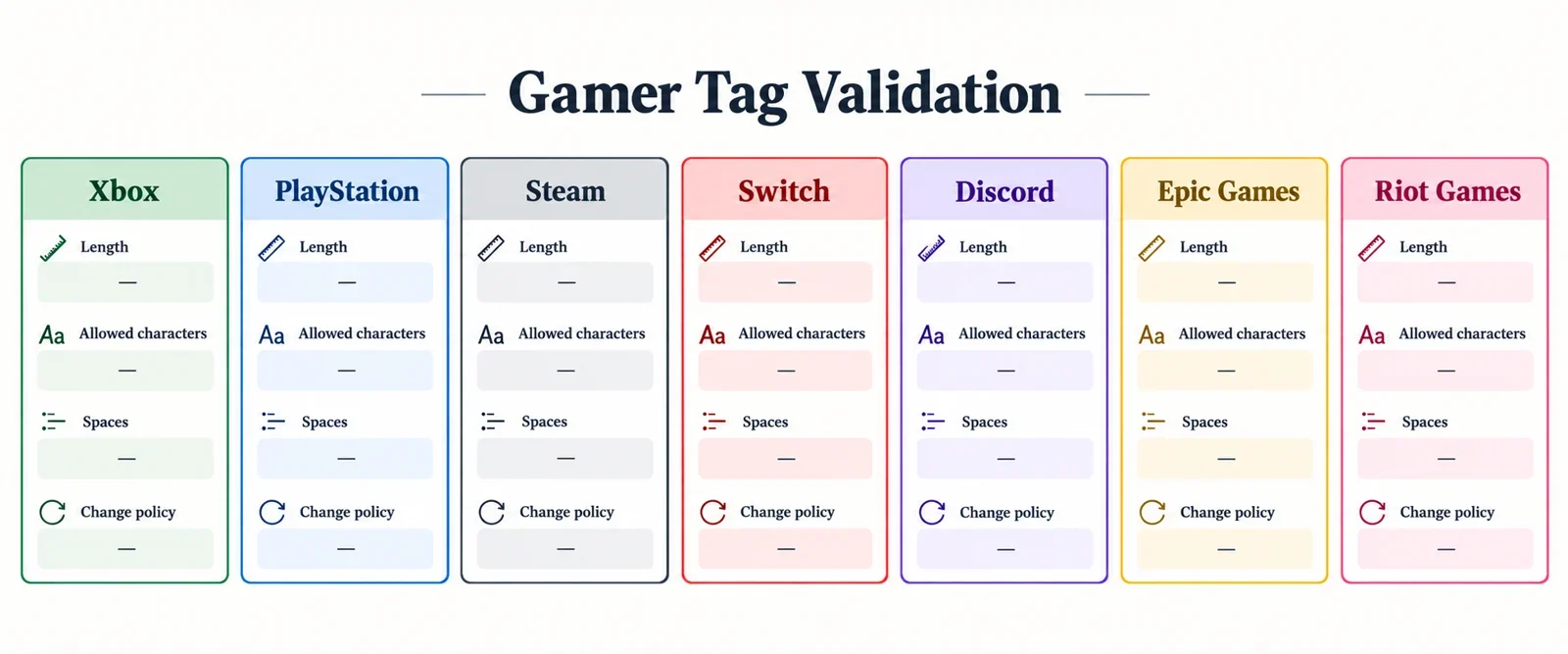
Platform rules are not identical. Xbox, PlayStation, Steam, Nintendo Switch, Discord, Epic Games, and Riot Games each control their own namespaces and display-name policies. Some systems separate a searchable handle from a visible display name; others apply different rules to account IDs and in-game names. Spaces, symbols, and change policies can vary by service and can change over time. Do not assume spaces are allowed in Xbox gamertags or any other platform name after an announced update; verify in the current account settings.
For a tag that travels across platforms, the safest design target is the tightest common ceiling rather than the most generous one. A conservative approach is to build within the tightest active platform profile, use letters and numbers only, and start with a letter. Do not rely on spaces or stylised symbols. A single availability check is not enough: confirm the name platform by platform, and check the platform’s official support pages for current limits, change fees, and PSN ID change rules before committing.
Short and callout-friendly naming patterns
Callout-friendly names are short, distinct, and hard to mishear. In Apex, a teammate may say a name while gunfire, ability audio, and voice comms overlap, so the best patterns avoid ambiguous homophones. Letters that sound like words or other letters, such as B and be, C and see, and pairs like 0 and O or 1 and I, create unnecessary confusion. Numbers that sound like letters are especially risky in a short Apex Tag.
A practical pattern is a one-to-three-syllable stem with a clear consonant-vowel shape. Names like Vyxe, Kaze, Oryx, Rhox, and Jynx show the value of odd letter pairings: they are short, pronounceable, and often easier to claim than ordinary dictionary words. The generator can combine a crisp opening consonant with a short vowel and a clean ending, then reject results that contain confusing number-letter substitutions or awkward clusters. There is no official syllable recommendation for Apex voice chat, so the practical test is to say the name aloud under pressure.
For voice chat, shorter is usually better. A short display name or handle gives teammates enough shape to remember without turning every callout into a spelling lesson. The Apex Tag itself should stay within the current alphanumeric limit. The generator should also flag names that are too close to common callouts, map locations, Legend names, weapon names, or teammate names, because clarity matters more than cleverness.
Squad-ready prefixes and duo/trio themes
A duo or trio can share an identity without sharing the exact same name. The strongest squad schemes use a common prefix, stem, or theme and then give each player a distinct tail. A shared short Apex Tag can act as the squad marker, while each player’s handle or display name carries the individual role. This keeps the group recognisable in lobbies and scoreboards without making every callout sound identical.
Common themes include colour families, elements, weather, military-style callsigns, and short abstract stems. A colour squad might use Ash, Ember, Frost, Onyx, and Vex as a palette. An element squad might use Storm, Tide, Solar, Void, and Gale. A military-inspired squad might use Alpha, Bravo, Delta, Echo, and Nova. The generator should produce a shared root plus unique endings, then check that each result remains distinct when spoken aloud.
For duos, a two-part contrast works well: one shared stem and two clearly different suffixes, such as a quiet root with a hard ending and a soft ending. For trios, avoid three names that differ by only one letter, because voice chat can blur them together. The squad filter should enforce a minimum audible distance between teammates, keep the shared identity obvious, and still respect the tightest active platform ceiling for cross-platform play.
Legend main identifiers and role-based suffixes
Legend names are useful identity cues, but many are too long to fit inside a short Apex Tag. The generator should therefore treat Legend references as optional flavour rather than mandatory fields. A Wraith main might use a short root such as Wra, an Octane main might use Oct, and a Bangalore main might use Bang, but these roots should only be used when the squad already recognises them. There is no universal official abbreviation set that every Apex player will decode.
Role-based suffixes are more reliable when they are short and explicit. IGL, frag, anchor, scout, and flex are common role ideas, but the generator should not force them into the Apex Tag if that would crowd out clarity. A better pattern is to keep the Apex Tag neutral and place the role cue in the longer display name or handle, where there is more room. That also makes the tag easier to reuse when a player changes roles.
Players who switch Legend mains mid-season should not have to rebuild their entire identity. The generator can offer a neutral tag plus a Legend-specific display variant, or a Legend filter that suggests roots without locking the account name to one main. Every suggestion should still pass the alphanumeric rule, the active length ceiling, and a read-aloud check before it is presented as squad-ready.
Ranked play naming conventions
Ranked naming is less about a single official rule and more about tone, trust, and coordination. A ranked filter can favour names that sound calm, readable, and team-oriented, while avoiding stems that read as meme-heavy, taunting, or intentionally confusing. The generator should not promise statistical credibility through tags like ADR or K/D unless the player actually wants that identity and the platform allows the characters.
A useful ranked mode can offer three tones: neutral, tactical, and competitive. Neutral names stay clean and easy to call. Tactical names use short role or squad cues without pretending to be official. Competitive names use crisp, confident stems but avoid overclaiming. The filter should also reject names that are likely to be read as impersonation, harassment, or bait, because platform rules and EA’s terms apply on top of any in-game naming policy.
Unwritten community preferences vary by region, rank, and squad. Some players avoid ‘clutch’ or ‘sweat’ signalling because it can read as taunting; that is a community preference, not a platform rule. Rather than hard-coding a claim about what all ranked players want, the generator should expose filters and let the squad choose. A good default is a name that is short, distinct, free of ambiguous homophones, and free of fake stats.
Understanding the Apex Gamer Tag Generator
The Apex Gamer Tag Generator works as a constraint-first naming tool. It starts with the squad size, the platform target, the desired tone, and optional identity cues such as a Legend main or role. It then combines a short prefix or stem with a distinct suffix, checks the result against alphanumeric and length rules, and removes duplicates or names that are too close to another teammate’s callout.
The persona alignment layer is what separates a useful generator from a random name list. A duo that wants a shared colour theme should receive names that sound related but remain easy to tell apart. A trio that plays ranked should receive calmer, more tactical options. A player who mains Octane should see Legend-adjacent suggestions without being forced into a name that only makes sense for one season.
The output should be presented as a shortlist, not a single verdict. Each result can show the Apex Tag, the longer display suggestion, the platform ceiling it fits, and a read-aloud warning if it contains a risky sound. That gives the squad enough context to choose a name, test it in voice chat, and then verify availability on each platform before committing.
Procedural Syntax & Formatting Constraints for Apex Gamer Tags
The formatting rules should be explicit in the generator logic. The Apex Tag is a short alphanumeric field that appears before the username. It should not contain spaces, punctuation, or stylised Unicode. The longer handle or display name can follow platform-specific rules, but the safest cross-platform pattern is still letters and numbers only, starting with a letter.
Casing should be readable rather than decorative. Title case or clean all-caps works better than leetspeak, because substitutions such as 0 for O or 1 for I create callout ambiguity. The generator should reject strings that begin with a number, contain repeated characters that are hard to distinguish, or rely on symbols that one platform may accept and another may reject.
Validation should be config-driven. A platform profile can store the current minimum, maximum, allowed character set, and whether spaces or symbols are permitted. The generator then applies the strictest active profile when the squad wants one tag for multiple platforms. A conservative ceiling, letters and numbers only, and a letter-first rule will not guarantee availability, but it will reduce the chance of building a name that fails on the next platform.
Contextual Heuristics & Lexicons
The lexicon should be organised by theme so the generator can produce coherent squads rather than random mixes. Useful prefix families include colour stems such as Ash, Ember, Frost, Onyx, and Vex; elemental stems such as Storm, Tide, Solar, Void, and Gale; military-style stems such as Alpha, Bravo, Delta, Echo, and Nova; and abstract stems such as Nyx, Rook, Kaze, Oryx, and Jynx.
Suffix families should create distinction without breaking the shared identity. Short endings like -ex, -ox, -yn, -ar, and -is can follow a common stem, but the generator should test the full result aloud. Role cues such as IGL, frag, anchor, scout, and flex can be offered as optional display-name tags rather than forced into the Apex Tag. Legend roots such as Wra, Oct, Bang, Path, and Lif can be suggested only when the player selects a main.
The heuristic layer should also include negative filters. Reject names that sound like common map callouts, weapon names, or Legend names unless the player explicitly wants that association. Reject number-letter substitutions that blur in voice chat. Reject strings that are one letter away from another teammate’s name. The lexicon is there to spark identity, not to override clarity or platform safety.
Comparative Analytics: Generator vs. Manual Ideation
A generator is strongest when speed, constraint checking, and squad consistency matter. Manual ideation is stronger when the player has a personal story, an inside joke, or a very specific identity that no word list can predict. The table below compares the two approaches on the criteria that matter most for Apex squad tags.
| Criterion | Generator | Manual Ideation |
|---|---|---|
| Uniqueness | Produces many odd letter pairings and themed variants quickly | Can produce a highly personal name, but may stall on availability |
| Availability | Can generate large batches and flag likely conflicts | Requires repeated manual checking and rewriting |
| Speed | Fast, especially for duos and trios that need matching names | Slower, because each name must be tested and compared |
| Suitability | Strong for length, character, and callout filters | Strong for personal meaning, weaker on platform constraints |
| Squad consistency | Can enforce shared prefixes and audible distance | Depends on the group’s coordination and patience |
A hybrid workflow is usually best. Use the generator to produce a shortlist that already fits the platform ceiling and callout rules, then let the squad choose the option with the right personal meaning. Manual tweaks should be re-checked by the same validator, because a clever edit can accidentally introduce a symbol, a confusing number, or a length overrun.
Frequently Asked Questions
What are Apex Legends Tags?
Apex Tags are the short alphanumeric identifiers shown before a username. They appear wherever the username appears, so they should be treated as part of the player’s callout identity, not as decorative text. Confirm the current in-game field rules before finalising a tag.
How do you make one tag fit Xbox, PlayStation, Steam, and Switch?
Build for the tightest common ceiling rather than the most generous platform. Use letters and numbers only, start with a letter, and avoid assuming that spaces or symbols are allowed. You still need to verify the current rules in each platform’s account settings or official help centre.
Can a single tag be checked once and used everywhere?
No. Each platform controls its own namespace and display rules, so availability and character limits must be checked platform by platform. A name that is free on one service may be taken, restricted, or formatted differently on another.
How should a player include a Legend main or role without exceeding the limit?
Use a short Legend root only if the squad already recognises it, or keep the Apex Tag neutral and place the Legend or role cue in the longer display name. Players who switch mains mid-season can keep the same short tag and change the display variant. Also check EA’s terms and the target platform’s content rules, because impersonation, harassment, hateful content, and misleading stat claims can be restricted even when the name fits the character limit.