Contents
A great gamer handle does two jobs at once: it survives being shouted in voice chat at 1 a.m., and it stays readable when the scoreboard shrinks it to eight pixels tall. That is why short, punchy names keep winning — they are faster to say, easier to remember, and far less likely to be mangled by a stranger’s microphone.
This page puts the generator first. Tap a handle to copy it, heart the ones you like, and generate again for fresh ideas without repeats during a visit. Below the tool, the guide explains the reasoning behind the output: how short-handle syntax works, how platform rules shape what a name can contain, which word pools suit which playstyle, and where a generator stops and your own judgement has to take over.
Tool Widget and Above-the-Fold UX
What belongs above the fold
The top of the page should make three things obvious: what the tool does, how to get a fresh batch of ideas, and how to keep a shortlist. The H1 names the tool — Cool Gamer Name Generator — and a one-line prompt sets the expectation: short handles that are easy to say and easy to read on a scoreboard. The result area, not a long introductory paragraph, should be the visual focus.
The supported interaction model is simple. A user taps a generated handle to copy it, taps a heart to save it to favorites, and generates again for new ideas without repeats during the visit. That is the core loop: browse, copy, favorite, regenerate. Any additional controls should serve that loop rather than compete with it.
The reference tool behind this style of generator also exposes length and character options. Users can set length, including short tags of eight characters or fewer, exact 3–5 letter tags, or platform limits, and can add numbers, frames, leetspeak, separators, symbols, or clan tags. Those controls are useful because they let a player test a style quickly, but they are not a substitute for checking the final name on the platform itself.
Local word bank, instant output
The generator should assemble candidates in the browser from prefix and suffix tables. A local word bank keeps the interaction instant and avoids sending a name idea to a server. Curated banks of this type stay modest in vocabulary but broad in range: the reference generator works from roughly 1,364 hand-picked words, plus 47 Japanese words and 86 clan words, with rude terms and real game, character, and famous-player names filtered out before generation begins.
An illustrative slice of a local bank can look like this:
const PREFIXES = ['Ace','Blitz','Cinder','Cobalt','Drift','Echo','Ember','Flux','Frost','Ghost','Glint','Havoc','Hex','Iron','Jade','Kite','Lunar','Nova','Onyx','Pulse','Quartz','Rift','Rogue','Saber','Shade','Sly','Spark','Storm','Talon','Vex','Void','Zen'];
const SUFFIXES = ['blade','bolt','byte','claw','core','dash','fang','fire','flux','gear','hawk','hunt','jolt','knight','lore','mite','nova','paw','point','raid','ray','runner','shot','sight','snipe','spark','storm','strike','tail','tide','vault','wing'];
const ACCENTS = ['x','z','_','.'];
The snippet is an example of structure, not a claim that every generator uses the same inventory. The important design point is that the bank is curated, local, and filtered for tone before any name reaches a card.
What not to promise
The widget should not imply that it has checked availability, reserved a name, or cleared a trademark. It generates ideas. The player still has to verify the finalist in the platform’s name field.
Short, One-Word, Initials, and Symbol-Accented Handle Styles
Three handle shapes, not three guaranteed modes
When players ask for a short gamer name, they usually mean one of three handle shapes. These are naming patterns to evaluate, not a promise that every generator exposes them as separate modes.
One-word tags are a single compact token such as Vex, Cinder, or Rift. They are memorable, easy to read at scoreboard size, and easy to say in voice chat. The trade-off is supply: short single words are limited, so the plain form may already be taken. A small, deliberate modifier — one digit, one separator, or a short second syllable — often makes the difference between a name that works and a name that is unavailable.
Initials-based handles use a short letter cluster as a personal anchor, then attach a word from the lexicon. Two or three letters is usually enough. A longer cluster starts to read like a serial number, and it becomes harder to say naturally. The best initials builds sound like names, not like account codes: the letters should flow into the word rather than interrupt it.
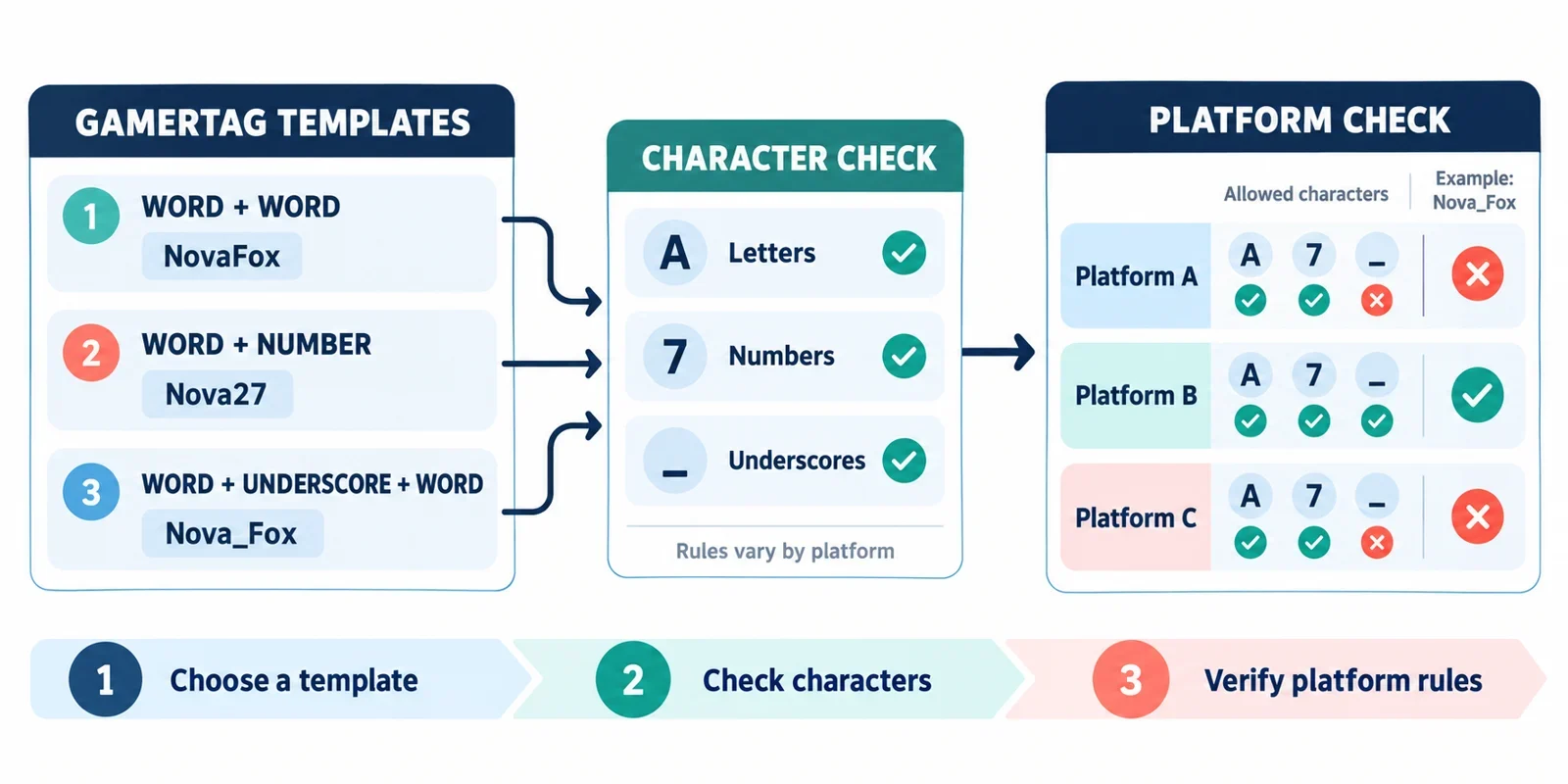
Symbol-accented handles add one separator or accent between two parts — an underscore, a period, or a doubling letter. Used sparingly, one accent can rescue a name that would otherwise be taken, and it can add visual rhythm. Used carelessly, it becomes noise. Stacked underscores, alternating cases, decorative brackets, and multiple symbols make a name harder to type and much harder for another player to search.
Guardrails for all three
Every shape should pass the same checks. The handle must be pronounceable on first read — no consonant pile-ups and no strings of four vowels. It must stay compact enough to read on a scoreboard and to say in one breath. It should use plain letters that survive a search box. And it should never contain a real name, school, birth year, postcode, or other identifying detail dressed up as a gamer tag.
Symbols and numbers are optional tools, not default ingredients. A clean name that is easy to find is usually stronger than a decorated name that looks distinctive but cannot be typed from memory.
Procedural Syntax and Platform Constraints
Common syntax patterns
Short handles usually follow a small set of syntax patterns. These patterns are useful for manual ideation and for evaluating generated ideas; they are not a claim that every generator uses a fixed template table.
| Pattern | Example shape | What it is for |
|---|---|---|
| Prefix + suffix | Frosthawk | The compact two-part core; the most common shape |
| Prefix + suffix + one digit | Frosthawk7 | A disambiguator that adds almost no length |
| Initials + suffix | KVstrike | A personal anchor welded to a punchy noun |
| Word + one separator + word | Nova_Rift | Visual rhythm; one separator only |
| Standalone short word | Vex | Maximum impact, hardest to find unclaimed |
The practical rule is to keep the core short enough to read on a scoreboard and to say in one breath. A compact core is also the most portable choice, because it is more likely to survive the tightest limit a player encounters without needing a rewrite for every platform.
Where the real limits live
Xbox, PlayStation, Nintendo Switch, and Steam each publish their own display-name rules. The limits and allowed character sets are revised periodically, so a third-party summary is a weak substitute for the platform’s own support page. Treat the platform itself as the source of truth.
| Platform | What to verify before committing |
|---|---|
| Xbox | Current gamertag length limit and allowed characters, from Xbox’s official support pages |
| PlayStation | Online ID minimum and maximum, plus any restriction or change policy |
| Nintendo Switch | Nickname length and permitted characters |
| Steam | Profile name rules, which are separate from the account login name |
A handle that clears the tightest limit you actually play under is the one worth keeping. Anything longer can be trimmed per platform.
Casing, symbols, and verification
Casing is not a reliable separator. Two names that differ only by capitalization may not be treated as distinct, so do not build a handle around a stylized capital pattern. Symbols are the riskier variable: permitted sets vary, and some platforms reject or strip glyphs that others accept. A handle that leans on brackets or unusual characters often becomes unsearchable even when it is technically legal.
Before committing, run a three-step check: paste the handle into the platform’s name field and watch for rejection, search the exact string to see whether a near-identical account already exists, and read it aloud once to confirm it still works in voice chat.
Contextual Heuristics and Lexicons
Word pools follow playstyle, not just taste
The lexicon should be organised by the identity a player is trying to project, because a name that reads well in a ranked shooter rarely reads well in a farming sim. Each pool carries its own prefix and suffix bias.
| Persona | Prefix bias | Suffix bias | Example output |
|---|---|---|---|
| Competitive | hard consonants, short vowels | strike, bolt, sight, point | Vexstrike |
| Casual | soft, friendly, rounded | paw, tide, dash, wing | Jadedash |
| Edgy | dark, single-syllable | fang, hex, shade, void | Hexfang |
| Tech | clean, modern, synthetic | byte, core, flux, gear | Cobaltcore |
| Fantasy | mythic, elemental | lore, knight, ember, rune | Emberknight |
| Aesthetic | calm, natural, minimal | mist, jade, lune, drift | Lunemist |
How the pools are curated
Three filters keep the vocabulary usable. First, rude and insulting terms are excluded outright — a handle that gets reported is a handle that gets changed. Second, real game titles, established characters, and well-known professional player names are left out, since borrowing one invites impersonation reports and search confusion. Third, every candidate word is screened for pronounceability and for ambiguous spelling, because a name that three people spell three different ways will never be found by a friend request.
The practical result is a bank that stays modest in size but broad in range. A vocabulary in the low thousands — the reference model pairs roughly 1,364 hand-picked words with 47 Japanese words and 86 clan words — is enough to cover competitive, casual, edgy, tech, fantasy, and aesthetic identities without producing output that sounds like the same six names reshuffled.
Choosing a pool
The pool should match the setting where the name will be seen most often. A competitive player who appears on ladders and scoreboards benefits from hard, clipped vocabulary. A casual player who joins party lobbies benefits from softer sounds that are easy to shorten into a nickname. An aesthetic player may care more about how the name looks in a profile card than how it sounds in a shout. The generator can offer variety, but the player still has to choose the identity.
Memorability, Pronunciation, and Searchability
Why pronunciation is the real test
A handle has to survive two very different channels: the eye and the ear. On a scoreboard it is read in a fraction of a second at small size, which rewards clean silhouettes and distinct first letters. In voice chat it is spoken once, often by someone with a poor microphone, which rewards simple syllable structures and predictable spelling.
Strong short handles tend to have two syllables, a clear stressed beat, and no letter pair that can be read two ways. They avoid consonant clusters that require a pause, and they avoid homophones that turn a name into a punchline. A name that has to be spelled out letter by letter in every lobby is not short in practice, even if it is short on paper.
Compactness is a feature, not a compromise
Length costs the player in three places. It gets truncated in scoreboards and friend lists, it slows down typing in search fields, and it increases the chance of a collision with an existing account. A tight, compact handle sidesteps all three. Compactness also helps the name travel between platforms: the shorter the core, the less likely it is to hit a platform-specific ceiling or need a different version on every service.
Plain letters beat clever ones
Leetspeak substitutions — zeros for O, threes for E — look distinctive in isolation but break search. A friend typing the name naturally will use ordinary letters and find nothing. The same applies to look-alike Unicode characters that render like Latin letters but are stored differently: they can make two accounts appear identical, which is exactly the pattern platforms treat as impersonation. Plain alphanumerics are the only reliable way to stay findable.
The read-aloud test
Before keeping a name, say it three ways: as a shout across a lobby, as a calm introduction, and as a search query typed by someone who only heard it once. If any of those three fails, the name is not as strong as it looks. The best short handles are not just compact; they are stable across those three situations.
Comparative Analytics: Generator vs. Manual Ideation
Neither approach is strictly better; they solve different parts of the problem. A generator is a breadth machine, and manual ideation is a depth machine.
| Criterion | Generator | Manual ideation |
|---|---|---|
| Uniqueness | High volume of combinations, but built from a shared vocabulary, so the flavour repeats across users | Potentially one-of-a-kind, drawn from personal history or an inside reference nobody else shares |
| Availability | No reservation and no lookup — output is a suggestion, not a claim on the name | Same limitation, though a hand-picked oddity is statistically less likely to collide |
| Speed | Seconds to a full batch of candidates; ideal for exploring a style before committing | Minutes to hours; requires the player to already know what they want to sound like |
| Suitability for short, impactful handles | Strong — length and pronounceability can be constrained by design | Mixed — hand-made names drift long or drift clever, and often need trimming |
| Best used for | Breaking a blank-page block and mapping the space of available styles | Putting the final personal stamp on a shortlisted candidate |
The efficient workflow is sequential rather than competitive: generate a wide batch to find the style that fits, shortlist three or four, then apply manual polish — swap one syllable, adjust the initials, drop the digit — and verify the final version on the platform itself.
A generator is also useful when the player has no starting vocabulary. It can show that a competitive identity sounds different from a casual one, or that an aesthetic name needs softer consonants than an edgy name. Manual ideation is better once the player has a direction and needs a detail that no word bank would contain: an old nickname, a private joke, a two-letter combination with personal meaning.
The mistake is to treat either method as a complete solution. The generator cannot know which name will feel right in a lobby, and manual ideation cannot quickly map a whole style space. Used together, they cover both breadth and personality.
Trust, Availability, and Compliance Caveats
What the generator cannot do
A name generator produces ideas. It does not reserve a handle, does not query any platform’s account database, and does not check whether a name is already registered, trademarked, or restricted. A handle appearing in the result grid means only that it was assembled from the word bank — nothing more.
What the player still has to do
- Verify on the platform. Type the candidate into the actual name field for Xbox, PlayStation, Switch, or Steam and see whether it is accepted and still free.
- Check for impersonation risk. Search the exact string; if a near-identical account exists, pick another candidate.
- Re-read the current rules. Allowed characters, length ceilings, and name-change costs are revised periodically. The authoritative answer lives on each platform’s official support pages, not on a third-party summary.
- Keep personal data out. No real names, birth years, school names, postcodes, or contact handles — in any spelling, including leetspeak.
- Avoid look-alike characters. Glyphs that imitate Latin letters can render two different accounts identically and are commonly treated as deceptive.
A note on tone
Edgy vocabulary has a ceiling. A handle that reads as aggressive toward a group of people rather than toward an opponent will get reported, and reports cost more time than a rename. The safest filter is simple: if the name would need explaining in a mixed lobby, it is not worth the friction.
Compliance is a final check, not a generator feature
The word bank can exclude rude terms and real game, character, and famous-player names, but that is a curation choice, not a legal clearance. Trademark, impersonation, and platform-specific restrictions still need a human check. The generator should be presented as an ideation aid, and the player should be presented as the final decision-maker.
FAQ Schema and High-Intent Answers
What makes a cool gamer name short and impactful?
Three things working together: it is easy to say out loud, it stays legible at scoreboard size, and it uses plain letters a friend can type from memory. Short names win because they are faster to read and say, but shortness alone is not enough — a compact name with an ambiguous spelling is harder to use than a slightly longer one with a clean sound.
How short should a gamer name be to fit Xbox, PlayStation, Steam, and Switch?
Short enough to stay readable on a scoreboard, easy to say in one breath, and short enough to clear the tightest limit you actually play under. Because each platform sets its own ceiling and revises it from time to time, check the current figure on that platform’s official support page rather than trusting a summary. If one handle has to travel across several platforms, keep the core compact and let the platform field do the trimming.
Should I use symbols or numbers in a short gamertag?
Sparingly, and only if they add something. A single digit or one separator can rescue a name that would otherwise be taken, and it can help distinguish you from a similar account. What it cannot do is make you findable — numbers and symbols break search, and leetspeak substitutions make a name nearly impossible for a friend to type. If a clean version exists, take the clean version.
Can the generator check whether a gamer name is available?
No. The tool assembles candidates from a local word bank in your browser and has no connection to any platform’s account system, so it cannot confirm availability, reserve a name, or clear a trademark. Use it to generate and shortlist, then verify each finalist directly in the platform’s name field.