On this page
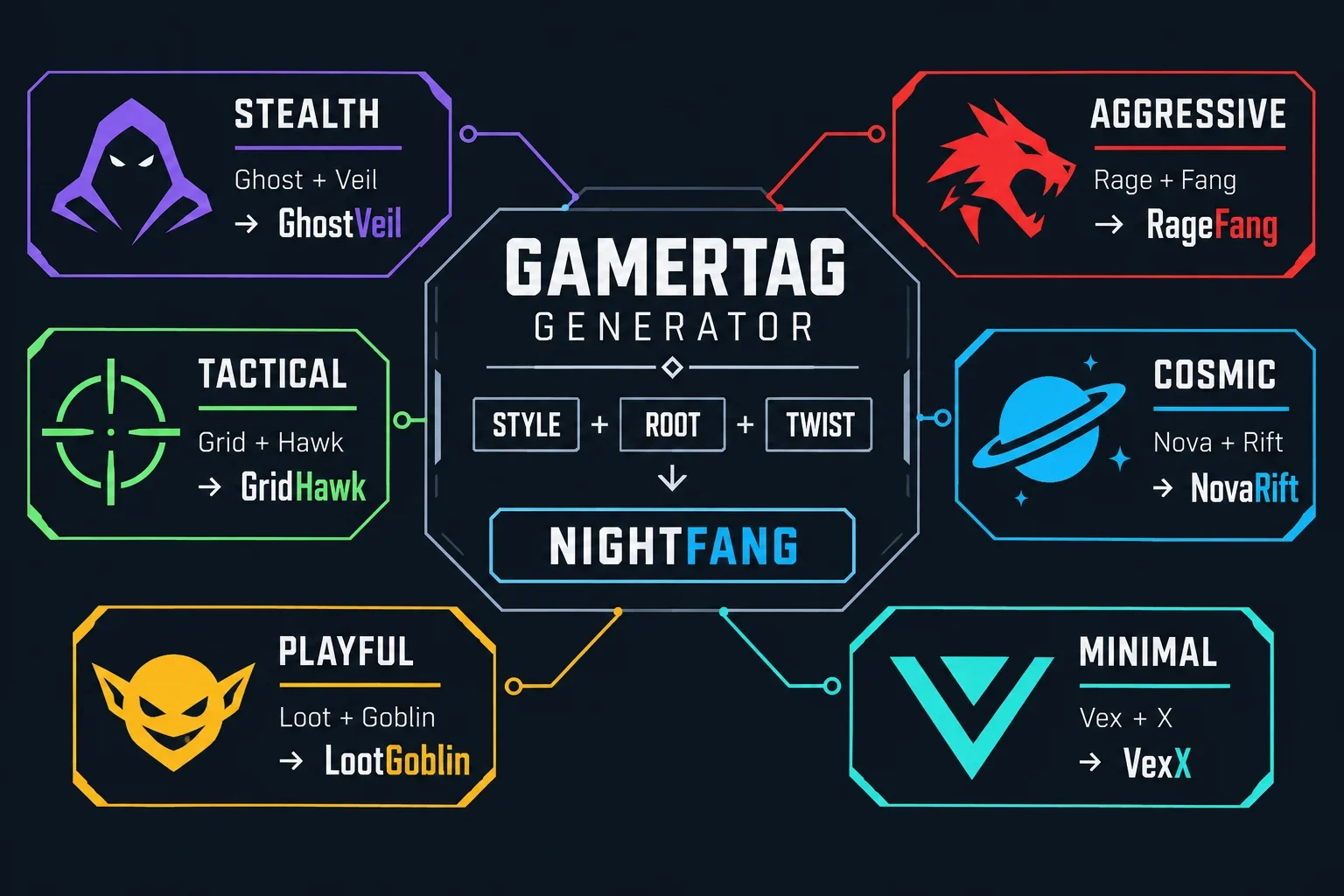
Your Fortnite display name is the first thing a lobby sees and the word your squad shouts when they need a revive. It sits on the scoreboard, in the kill feed, and in every party invite, which is why players spend so long hunting for one that feels right. This Fortnite Name Generator produces bold battle-royale gamertags across six popular styles — sweaty, tryhard, funny, aesthetic, clan, and streamer — by combining style-specific word pools, optional keywords, and formatting patterns that match the persona you want to project.
The generator is an idea machine, not a registry lookup. It cannot tell you whether a name is already claimed on Epic Games, and it does not perform trademark or sensitivity checks. What it can do is hand you a batch of structured starting points in seconds, so you spend your time refining a shortlist instead of staring at an empty text field. Read on for the character limits, the naming rules around impersonation and Epic references, the symbol-rendering traps, and a practical way to test your final pick before you commit.
Understanding the Fortnite Name Generator
A name generator is a small creative engine. It holds a pool of style-tagged words — aggressive verbs, calm nouns, clan syllables, streamer suffixes — plus a set of formatting templates, and it stitches them together so every result already looks like the style you picked. Nothing is invented from thin air, and no live account data is involved.
Style pools do most of the work
Each lane carries its own vocabulary and its own punctuation habits. A sweaty lane leans on lowercase roots, underscore separators, and a numeric tail. A clan lane leans on a short team tag plus a hard-edged noun. A funny lane leans on puns and domestic absurdity. Because the pools are tagged rather than shared, a result from the aesthetic lane never accidentally arrives wearing a tryhard bracket tag. That separation is what makes the output feel deliberate instead of scrambled.
Formatting patterns set the silhouette
Words alone do not make a gamertag look like a gamertag. The template layer decides where underscores land, whether a tag sits at the front or the back, whether the whole thing is lowercase, and whether a number gets appended. Two names built from the same two words can read completely differently depending on those choices, which is why the patterns matter as much as the vocabulary.
Optional keywords make it personal
A common feature is an optional keyword box. You type a word — a nickname, an animal, a colour, a short inside joke — and the generator weaves it into a portion of the results while keeping the lane’s formatting intact. Enter "wolf" in the sweaty lane and you might see a lowercase wolf root with an underscore and a numeric tail; enter the same word in the clan lane and it may arrive behind a bracketed team tag. The keyword personalises the output without breaking the style.
Deterministic, not magical
A generator built this way is deterministic: the same inputs produce the same outputs, and decorated variants are drawn from fixed character sets rather than being invented on the fly. That predictability is a feature. It means you can regenerate a batch, spot the pattern you like, and then rebuild it by hand with small changes.
What it cannot do
It cannot confirm that a name is free, cannot reserve one, and cannot tell you whether a name will be flagged. Treat every result as a proposal that still has to survive the real account field.
Procedural Syntax & Formatting Constraints for Fortnite Names
Epic’s display-name rules are the frame every generator has to work inside. Knowing them before you fall in love with a name saves a lot of disappointment.
The 3–16 character window
A Fortnite display name must be at least 3 and no more than 16 characters. Every letter, digit, space, underscore, bracket, and decorative glyph counts toward that total. This is why so many strong gamertags look compressed: there simply is not room for a long phrase plus punctuation plus a number. Sketch your favourite idea, count it honestly, and trim before you get attached. If a name is one character over, the fix is usually to drop a separator rather than to shorten the word that gives the name its meaning.
Shorter is usually better
Names in roughly the four-to-eight character range are easier to call out in voice chat, fit scoreboards without crowding, and are far less likely to be truncated in menus or party lists. Long names are not forbidden, but they cost you readability in exactly the moments when readability matters most.
The change cooldown
Epic enforces a waiting period between display-name changes, and the remaining time is displayed in your account settings. The exact length can vary and may be reported differently over time, so the number that counts is the one your own account shows. Practically, this means a name you set in a hurry can stick with you for a while, so run your shortlist through a real test before confirming.
Symbols, spaces, and Unicode risk
Spaces and many symbols are permitted, but decorative Unicode is a gamble. A glyph can render as a missing-character box, be normalised into something plainer, be rejected outright, or simply make your name harder to read for screen readers and search. The outcome depends on the device, the app, the operating system, and the installed font — so a star or a stylised script that looks immaculate on a desktop monitor may look broken on a phone or a console. If you use decoration, keep it to one element, and test it on more than one device.
Content rules worth respecting
Names may not contain offensive material, may not impersonate Epic staff or imply official affiliation, and should not include direct references to Epic or its brands. Private personal information — a real full name, a phone number, an address, a school — has no place in a public display name either. These are not stylistic preferences; they are grounds for a forced rename or a report.
Display name versus console ID
Your Epic display name is separate from a PlayStation Network ID or an Xbox gamertag. Depending on platform and settings, teammates may see the console identity rather than the Epic one, so a name that looks perfect in one place can appear differently in another. If consistency matters, plan to update both.
Always test in the real field
The most reliable way to confirm a name is to type it into Epic’s own account settings, where the field enforces the character limit and reports whether a name can be used. Type your finalist there before you commit.
Contextual Heuristics & Lexicons
Style is mostly a set of small, repeatable habits. Once you can recognise the habits, you can read a gamertag and guess the player’s intent before the match even starts.
Sweaty
The sweaty lane is built on lowercase roots, underscores in place of spaces, and a two-digit number tail. Lowercase reads as fast and unbothered; the underscore keeps the name compact inside the character limit; the number adds a personal tag that also helps distinguish near-identical roots. Expect shapes like a short verb plus a two-digit tail, or a clipped noun with a trailing underscore pair. Avoid stacking two numbers and an underscore — you burn characters on punctuation and lose the word that carried the meaning.
Tryhard
The tryhard lane adds a bracketed tag to signal an individual, aggressive persona. The tag is short, usually one to three characters, and sits at the front or the back. The rest of the name is a hard consonant word: fracture, relent, instinct, override. The combination reads as a player who intends to take every fight.
Clan
Clan style looks similar but points somewhere different. Instead of an individual persona, the bracketed tag is a team prefix, and the word behind it is militant rather than personal. A short uppercase tag in brackets followed by a heavy noun is the classic shape. If you are recruiting, a consistent clan prefix across a squad is more recognisable than six unrelated cool names.
Funny
Funny names trade coolness for charm. The reliable formulas are the mock-title (a pompous honorific attached to something mundane), the confession (a name that admits a bad habit), and the mismatch (a gentle word attached to a violent verb). Keep the joke legible at a glance — if it needs explaining in voice chat, it will not land in a lobby.
Aesthetic
The aesthetic lane favours clean, quiet language: weather, light, stone, sleep, and soft consonants, often separated by a period or a single underscore. Decorative glyphs belong here, but only one, and only after you have confirmed it survives on a phone and a console. A restrained name in plain letters usually reads as more intentional than a name crowded with ornament.
OG
OG style signals tenure without stating it loudly. The vocabulary is early-era and understated, and the formatting tends to be plain rather than decorated. The pitfall is claiming a status you cannot back up; a name that quietly implies long service ages better than one that announces it. (Note: the main generator focuses on the six core styles, but OG is a recognised variant worth understanding if you encounter it.)
Streamer
Streamer names are built for being said out loud and typed into a search bar. A memorable root plus a short suffix — TV, GG, Plays, Live — is the standard pattern. Test it by spelling it to someone verbally; if they get it wrong twice, the name will be mistyped in every raid.
Cross-style habits
Readable two-part combinations work everywhere: one short base word plus one modifier, with punctuation only where it earns its character. Shorter names survive scoreboards and voice chat better. And if you use the optional keyword box, let the lane’s formatting do the styling rather than adding more decoration on top.
Comparative Analytics: Generator vs. Manual Ideation
Both routes end in the same place — a name typed into Epic’s display-name field — but they get there differently, and each is better at different things.
| Criterion | Generator | Manual ideation |
|---|---|---|
| Uniqueness | Produces many combinations quickly, but popular patterns repeat across users, so results can feel familiar. | Can be genuinely personal, especially when built from a private reference — though personal does not mean unclaimed. |
| Availability | No access to Epic’s account system; cannot confirm whether a name is taken. | Same limitation; you still have to test in the account field. |
| Speed | Instant batches in a chosen style, which is useful when you have no starting point at all. | Slower; requires brainstorming, filtering, and often several sittings. |
| Suitability | Strong at surfacing formats you would not have considered — bracketed tags, underscore patterns, suffix families. | Strong at encoding meaning: an inside joke, a nickname, a word that only your squad understands. |
| Style consistency | Keeps every result inside the lane you picked. | Easy to drift between styles and end up with something muddled. |
| Trademark and sensitivity | Not checked. | Not checked either, unless you look it up deliberately. |
Reading the table
The generator wins on volume and format literacy. It shows you the shape of a style — what a clan tag looks like at the front of a name, how far an underscore stretches a short root — and it does that in seconds, which is exactly what you need when you are starting from nothing.
Manual ideation wins on meaning. A name built from something only you and three friends understand cannot be generated, because the generator has never met you. The most durable gamertags usually come from this route.
The hybrid approach
Most players get the best result by combining the two. Generate a batch, pick the one structure that feels right, then rebuild it by hand with your own word in the same shape. You keep the style literacy the generator provided and add the personal meaning it cannot supply.
Two limits that apply to both
Neither method can confirm Epic availability, and neither performs trademark clearance. Availability is confirmed only when you attempt the change in your Epic account settings. If you intend to use the name commercially — a channel, a team brand, merchandise — check trademark records separately before you build an identity around it.
A practical shortlist routine
Generate a batch, cut it to five, count the characters on each, say each one out loud, and type the survivors into Epic’s display-name field one at a time. What is left after that filter is the one worth spending your cooldown on.
Frequently Asked Questions
How long can a Fortnite name be?
A Fortnite display name must be between 3 and 16 characters. Every letter, digit, space, underscore, bracket, and decorative glyph counts toward that total, so a name with several separators loses room for the words that carry the meaning. Names in the four-to-eight character range are easier to call out in voice chat, fit scoreboards cleanly, and are less likely to be truncated in menus. If you are close to the ceiling, drop a separator before you shorten the root word.
How can I avoid impersonation or prohibited Epic references in a Fortnite name?
Do not build a name that implies you are Epic staff, an official representative, or a well-known creator you are not. Avoid embedding the Epic name or its game brands directly, since those can read as a claim of affiliation. Skip anything that could be read as offensive, harassing, or hateful, and keep private information — real names, phone numbers, addresses, schools — out of the display name entirely. A useful test is to ask whether a stranger could reasonably believe the account speaks for Epic; if the answer is yes, choose something else. Names that break these rules can be reported and may be changed for you.
Can I use special characters or symbols in a Fortnite name?
Many symbols, spaces, and some Unicode characters are accepted, but acceptance is not the same as reliability. Decorative Unicode may render as a missing-glyph box, be normalised into a plainer character, be rejected, or reduce readability for screen readers and search — and the result varies by device, app, operating system, and font. A glyph that looks perfect on your desktop may look broken on a friend’s phone or a console. For the widest compatibility, stick to plain letters, digits, underscores, periods, and brackets, and if you do use decoration, limit it to one element and test it on more than one device.
Do Fortnite name generators check whether a name is available?
No. A name generator has no access to Epic’s account system, so it cannot see which display names are already claimed, cannot reserve one for you, and cannot predict whether a name will be rejected. Generators propose patterns; they do not verify anything. The most reliable check is to type the name into Epic’s own display-name field in your account settings, which enforces the character limit and tells you whether the name can be used. Because there is also a cooldown between changes, confirm availability and count your characters before you commit rather than after.