Table of Contents
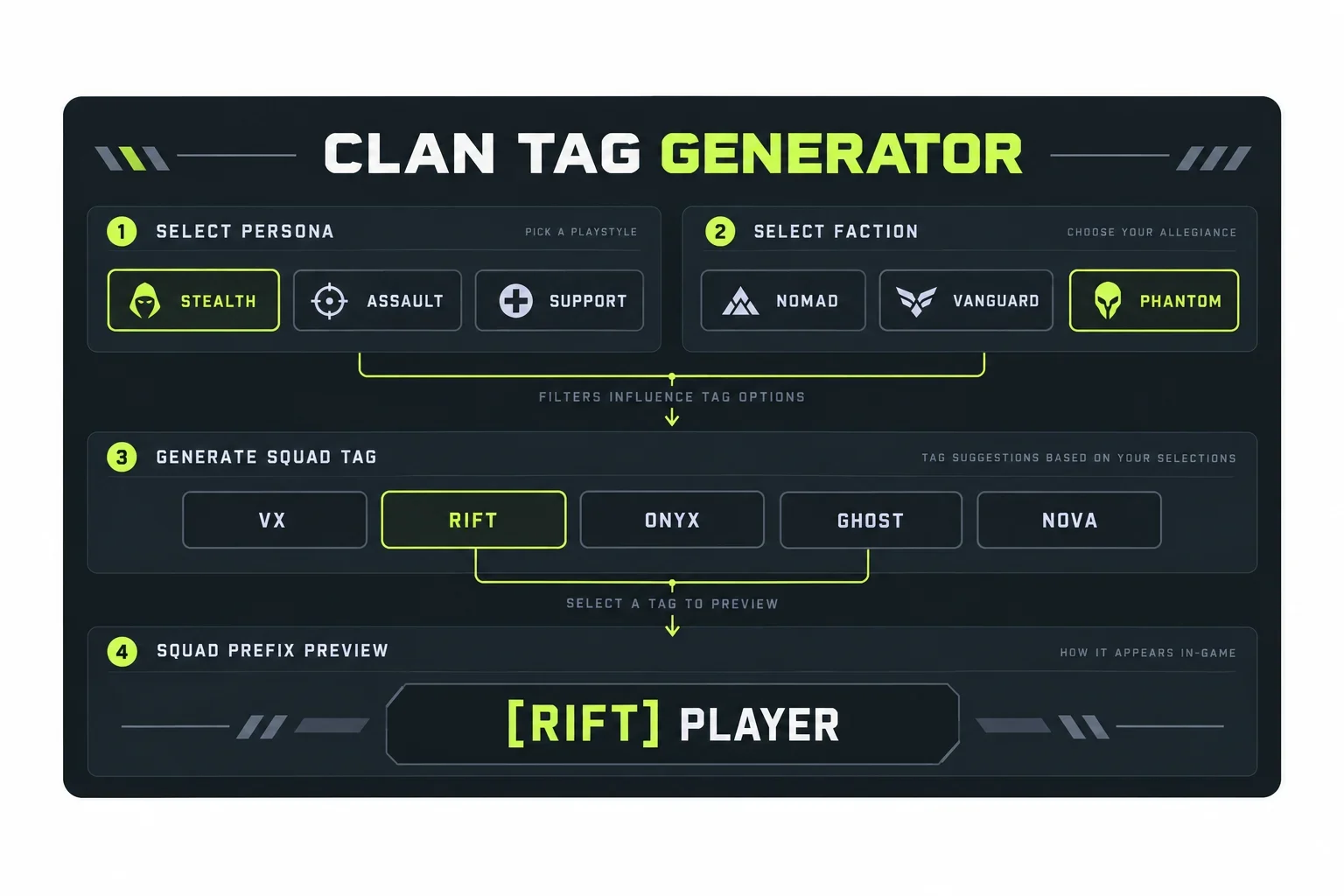
Finding a short clan tag that fits your squad’s identity and still stands out in the Warzone kill feed can feel like a sniper duel with no cover. A Warzone Clan Tag Generator solves this by compressing your team name into a punchy 2–5 character code that’s readable at a glance, works with tactical, funny, aesthetic, or faction themes, and doesn’t require hours of brainstorming. Unlike a full gamertag generator, a clan tag tool focuses on brevity, bracket formatting, and kill-feed visibility. This article explains how the generator combines themed prefixes and suffixes, what constraints apply to Warzone clan tags, how squad prefixes like [VOID] Kaze flow naturally, and why availability checks matter for clan tags versus full gamertags. You’ll also find a comparative table, a step-by-step workflow, and FAQ answers that cover the most common squad naming questions.
Understanding the Warzone Clan Tag Generator
A Warzone Clan Tag Generator is a browser-based tool that creates short squad tags in the 2–5 character range, aligning with tactical, funny, aesthetic, and faction personas. The generator uses themed prefix and suffix arrays—for example, stealth-oriented prefixes like Phantom and aggression-oriented suffixes like Krieg—and combines them into compact tags that remain readable in the kill feed. Because most games cap clan tags around three to five characters, the generator compresses squad identity into a punchy word or soundable initials that still read alone when displayed next to a player name.
The tool operates entirely client-side, meaning it generates names instantly in the browser without sending inputs to a server or requiring an account. This supports fast rerolling and privacy. Each output is treated as a suggestion, not a guarantee of availability; clan tag availability is checked separately through the in-game clan system or social platforms. The generator also includes count selectors (5, 10, 20 results), copy and favorite actions, and niche tag pills (Tactical, Funny, Aesthetic, Faction) to quickly filter results.
Key Distinction from Full Gamertag Generators
Unlike gamertag generators that produce long, unique handles, a clan tag generator focuses on brevity, bracket formatting, and kill-feed readability. Clan tags are commonly presented as a short tag in brackets alongside the longer clan name, which helps separate the squad code from the full identity. The generator’s output is intended for squad prefixes or standalone tags, not for creating full Activision or platform names.
Procedural Syntax & Formatting Constraints
Warzone clan tags must follow specific syntax and formatting rules to be effective and accepted by the game’s clan tag system. Here are the primary constraints to keep in mind.
Character Limits
Most games, including Warzone, cap clan tags at three to five characters. Some tools or systems may allow two characters, but three to five is the standard for readability and system compatibility. A generator should therefore default to the 3–5 character range and let users select a shorter or longer length if allowed.
Casing and Symbols
Uppercase letters are generally preferred for clan tags because they’re more visible in the kill feed and easier to read at a glance. Lowercase is sometimes allowed but can appear smaller or less distinct. Symbols (e.g., dash, underscore, pipe) are risky: some games restrict them, and they can make tags harder to read or cause errors during entry. Stick to letters and numbers for maximum compatibility.
Bracket Conventions
Clan tags are often displayed in brackets before the player’s name, such as [VOID] Kaze. The bracket style (square, round, or curly) may be automatically added by the game or customizable. When entering a tag, you usually type just the code, and the game wraps it in brackets. This means the tag itself shouldn’t include brackets—just the 2–5 character code.
Difference Between Clan Tag and Clan Name
A short clan tag (e.g., "VOID") is distinct from the longer clan name (e.g., "Void Squad"). The tag is the kill-feed identifier; the name is the full team label. Some systems require both, with the tag being a compressed version of the name. A generator should clarify that it produces tags, not full clan names.
Contextual Heuristics & Lexicons
The generator uses contextual heuristics—thematic keyword pools and prefix/suffix roles—to create tags that fit tactical, funny, aesthetic, and faction personas. Here’s how the lexicons work.
Tactical Lexicon
Tactical tags draw from military terms, stealth concepts, and battlefield motifs. Examples of prefixes: Phantom, Shadow, Vanguard. Examples of suffixes: Krieg (war), Ops, Unit. A combination could produce PHANTOM or OPSKRIEG (5 chars). These tags convey seriousness and coordination.
Funny Lexicon
Funny squad tags use humor, wordplay, or absurdity within the 2–5 character limit. Examples: SMOL, BAD, LOL, WUT, GGEZ. They often use abbreviations or slang that teammates and rivals find amusing. The key is staying readable—avoiding inside jokes that require explanation.
Aesthetic Lexicon
Aesthetic tags focus on style, symmetry, and visual appeal. Examples: VOID, NOVA, LUX, CORE, NITE. They often use symmetrical letters (V, X, O, N) and soft sounds. The goal is a tag that looks good in brackets and sounds cool when spoken.
Faction Lexicon
Faction-style tags use military etymology, ordnance terms, and battlefield motifs. Examples: FURY, AXIS, REAP, CYPH, DUST. They can sound like enemy teams from a campaign. A squad prefix like [VOID] Kaze shows how the tag flows naturally with a member’s name when spoken or read together.
Prefix and Suffix Roles
- Prefix: The tag itself (e.g., VOID). It’s the fixed part that identifies the squad.
- Suffix: Rarely used in tags themselves; more often, the suffix is part of the longer clan name. However, for generator purposes, suffixes can be added to prefixes to create novel combinations (e.g., KRIEG + OPS = KRIOPS).
Squad Prefix Ideas
- [PHANTOM] Razor
- [VOID] Kaze
- [FURY] Blitz
- [NOXA] Viper
- [SMOL] Bear
These examples show how a short prefix (2–5 chars) pairs naturally with a gamertag.
Comparative Analytics: Generator vs. Manual Ideation
Choosing between a generator and manual brainstorming depends on your squad’s need for speed, uniqueness, and creativity. The table below compares the two approaches across four key criteria.
| Criterion | Generator | Manual Ideation |
|---|---|---|
| Uniqueness | Suggests original combinations from themed arrays; no guarantee of unclaimed tags. | You can tailor tags to inside jokes or specific lore, but may accidentally reuse common patterns. |
| Availability | Not checked automatically; you verify later in-game or on social platforms. | You can check availability during brainstorming, but it slows down the process. |
| Speed | Produces dozens of tags in seconds; supports fast rerolling. | Requires hours of discussion and trial-and-error. |
| Suitability | Filters by niche (tactical, funny, etc.) to match squad persona. | You define suitability subjectively; can be more precise but time-consuming. |
Heuristic Takeaway: Use the generator for initial exploration and rapid prototyping. Then refine the top choices manually, checking availability and how they sound with your members’ names. The generator’s value lies in volume and variety, not guaranteed availability—treat its output as a starting point.
Availability Checks and Squad Prefix Workflow
Clan tag availability is different from gamertag availability. A gamertag is a platform-wide identifier (e.g., Xbox Gamertag, PSN ID, Activision ID). A clan tag is group-specific and may be reused across different games or platforms, though Warzone’s clan system may have its own uniqueness rules. Here’s how to check and what to do.
Checking Clan Tag Availability
- In-Game Clan System: In Warzone, you can change your clan tag through the Barracks or Social tab. Try entering your desired tag; if it’s taken, the game may tell you, or you’ll see it in use on other players’ profiles.
- Social Platforms: Check platforms like Discord, Reddit, or clan registries (e.g., Warzone Clans subreddit) to see if another squad uses the same tag. This isn’t official, but it helps avoid confusion.
- No Central Registry: Unlike gamertags, there’s no global database for clan tags. Many squads share the same tag across different lobbies. Originality still matters to avoid brand confusion.
Workflow for Your Squad
- Generate: Use the generator to create 10–20 short tags.
- Filter: Remove ones that are too long, hard to read, or clash with your squad’s vibe.
- Sound Test: Say each tag with each member’s name aloud (e.g., "VOID Kaze"). Listen for flow issues.
- Check Availability: Log into Warzone and attempt to set the tag in your clan settings. If taken, move to the next on your list.
- Finalize: Once you find an available tag that sounds good, assign it to the squad.
Why Original Tags Beat Borrowed Org Tags
Using a famous org tag like FaZe, Optic, or 100T might seem cool, but it creates identity confusion and can attract unwanted attention. Original tags are more memorable for your squad and avoid legal or social issues with esports organizations. A generator helps you craft a unique identity without copying.
Frequently Asked Questions
How many characters should a Warzone clan tag be?
Most Warzone clan tags are limited to three to five characters. Some games allow two characters, but three to five is the sweet spot for kill-feed readability and system compatibility. Avoid going over five, as longer tags may be truncated or rejected.
What makes a clan tag readable in the kill feed?
Readability comes from short length (2–5 characters), uppercase letters, and simple, distinct shapes. Avoid symbols like dashes, underscores, or pipes that can look like smudges. Choose letters that don’t blur together—like V, O, I, D, X, N, A—and steer clear of lookalikes like Q vs. O or I vs. l.
Should a squad use a prefix with each member’s name?
Yes, a squad prefix like [VOID] Kaze is a common and effective way to unify your team. The prefix should flow naturally with each member’s name when spoken or read together. Keep the prefix short (2–5 chars) and the member’s name longer, so the combination is balanced.
How do I check if a Warzone clan tag is available?
Clan tag availability is checked in-game through the Warzone clan system (Barracks > Clan). There is no global online database for Warzone clan tags, so you must log in and try to set the tag. You can also search social platforms to see if another squad uses the same code, but this isn’t official—if the tag is accepted in-game, it’s available to use.
Can I use symbols in a Warzone clan tag?
Symbols are generally not recommended. Most clan tag systems restrict symbols or may cause display issues. Stick to letters and numbers for maximum compatibility. If you must use a symbol, test it in-game before making it official.
What are good tactical clan tag examples?
Tactical tags include PHANTOM, SHADOW, VANGU, OPSKRIEG (if space allows), UNIT3, and RECON. These draw from military and stealth terminology. Use uppercase letters for best effect.
What are funny squad tags that still fit 2–5 characters?
Funny tags include SMOL, BAD, LOLZ, WUT, GGEZ, NOOB, and PWN. Keep them clean—avoid anything that could be interpreted as toxic. Humor is subjective, so check with your squad before settling.
How is clan tag availability different from gamertag availability?
Gamertags are platform-wide and globally unique (e.g., only one person can have a specific Activision ID). Clan tags are group-specific and may be reused across different squads, games, or platforms. Warzone’s clan system may allow duplicates, but checking in-game is the only way to confirm. Originality still matters for branding.
Should we use a famous org tag like FaZe?
No. Using a famous esports org tag can create confusion, attract negative attention, and potentially infringe on trademarks. It’s better to generate an original tag that represents your squad’s identity. A generator helps you create something unique without copying.
How can a generator produce faction-style tags?
Faction-style tags use military etymology, ordnance terms, and battlefield motifs. The generator’s faction lexicon includes prefixes like Phantom (stealth), FURY (aggression), and DUST (battlefield). Suffixes like Krieg (war) or Unit reinforce the faction feel. The combination of these terms produces tags that sound like enemy teams from a campaign.